Moonstone: The Stone That Moves With You
By Gina — GinaStars
Okay so I need to tell you about the first time I held a moonstone, because I think it explains everything about why I became so obsessed with it.
I was in this tiny shop — the kind that’s barely wider than a hallway, sandalwood incense burning, trays of stones everywhere. The woman behind the counter just picked one up and handed it to me without saying a word. No pitch, no explanation. Just put it in my palm and waited.
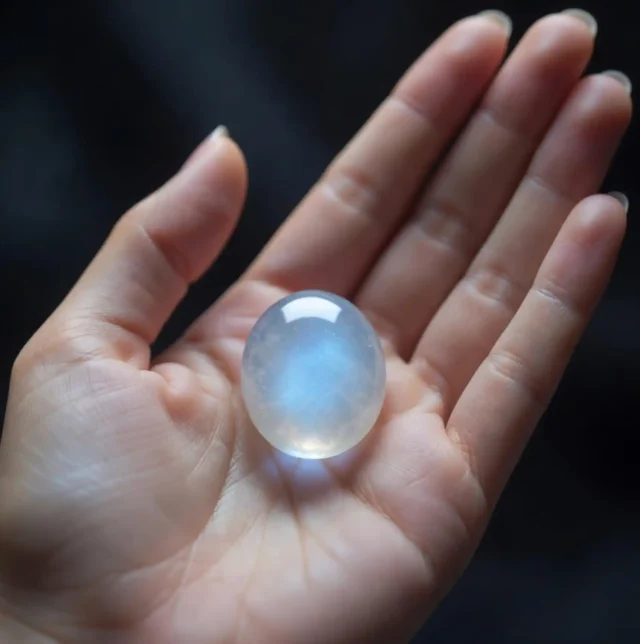
I turned it toward the light and this blue glow moved across the surface. Not a reflection exactly. Something underneath the stone, like a small cloud caught inside it. I stood there for probably a full minute not saying anything. Then I asked how much it was. She told me. I paid it. I didn’t even flinch and I was broke at the time.
That was seven years ago. That same stone is sitting on my desk right now, next to a half-drunk cup of coffee. It’s a little scratched. The glow isn’t as sharp as it used to be. I love it more than most things I own.
So. Moonstone. Let me tell you what I know about it.
What’s actually happening inside the stone
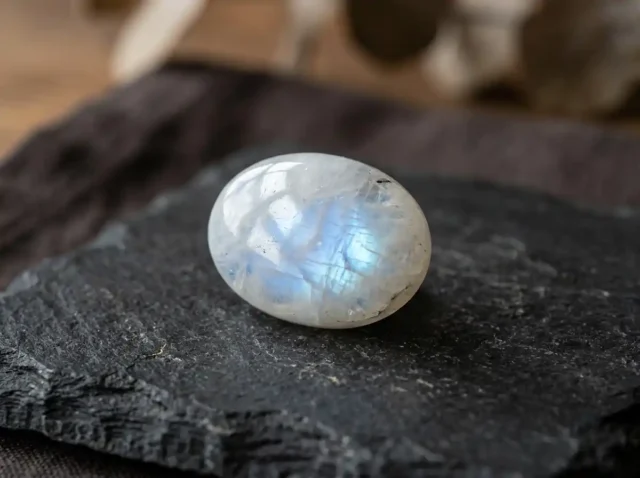
The blue shimmer has a proper name: adularescence. It comes from light scattering between thin layers inside the stone. Moonstone is a type of feldspar — orthoclase or albite — and those internal layers are what make it do that thing. As you move it, the glow moves too. It’s not painted on or treated. That’s just the structure of the stone doing something genuinely cool with light.
Which means every time you hold it at a slightly different angle, you’re seeing something different. I find this almost irritatingly satisfying. I have picked up the same moonstone hundreds of times and I still tilt it around for a minute every time.
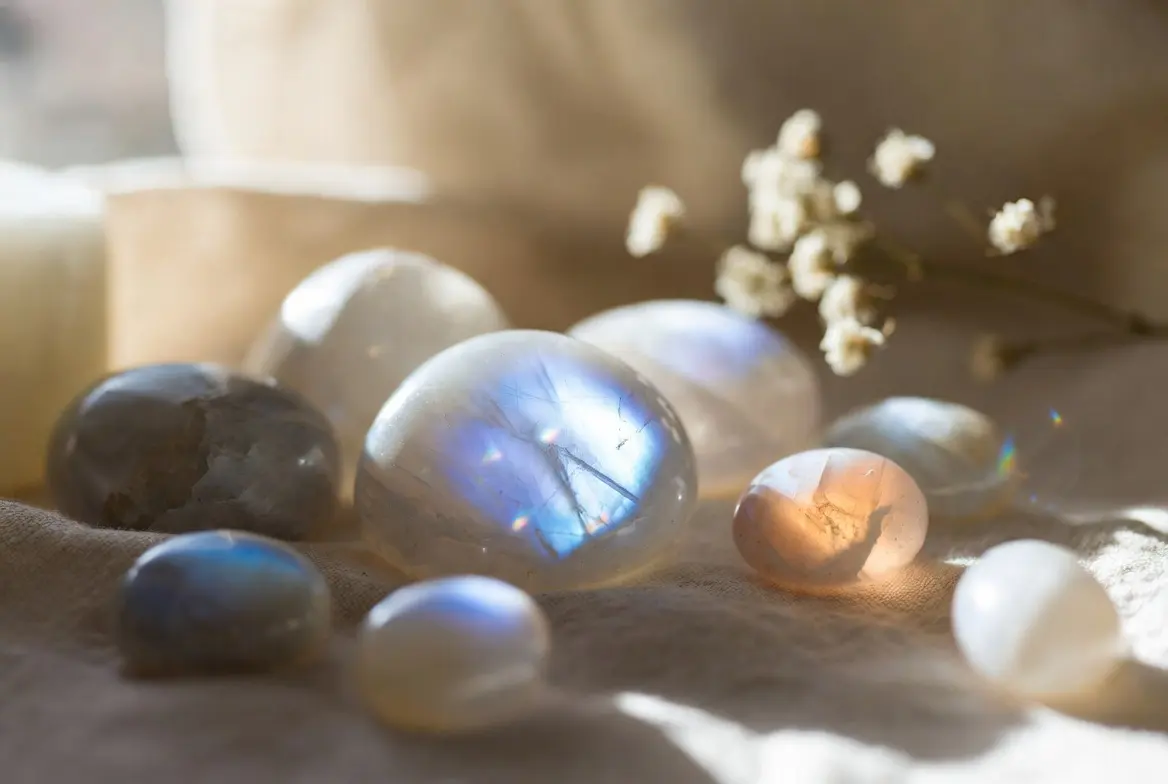
There are a few varieties worth knowing. White or grey moonstone with strong blue adularescence is the classic — the one most people picture. Rainbow moonstone (technically a type of labradorite, but close enough that shops sell it as moonstone) flashes in multiple colors and is more dramatic. Peach moonstone is warmer and softer-looking, kind of like holding a tiny sunset. Black moonstone is darker and more grounding, and I think it’s underrated.
The best stones for that deep blue glow come from Sri Lanka. Indian moonstone tends toward beige and brown tones with a subtler shimmer. Neither is better. It really is just about what you’re drawn to.
Two thousand years of people loving this stone
Here’s the thing I keep coming back to with moonstone: people have been obsessed with it for a very long time. Like, embarrassingly long. That doesn’t prove anything mystical about it, but I do think it’s worth sitting with.
Pliny the Elder wrote about moonstone in the first century AD. He believed the appearance of the stone changed with the phases of the moon, which — okay, that’s not accurate, but I find it charming that the Romans were staring at moonstones hard enough to notice patterns in them. They also believed the stone contained an image of Diana, goddess of the moon, inside it. Looking at that blue glow moving under the surface, I understand the impulse.
In India, moonstone has been considered sacred for centuries. It appears in Hindu mythology as a stone formed from moonbeams. Traditionally it was given as a gift between lovers. There’s also a tradition of placing it in the mouth during a full moon to see visions of the future, which I have not tried and honestly am not sure I want to.
Medieval Europeans thought it could reconcile estranged lovers and cure insomnia. Arab women sewed it into their clothing as a fertility stone. During the Art Nouveau period — early 1900s — designers like Rene Lalique used it constantly, drawn to that organic, water-like quality.
All of these cultures, across wildly different times and contexts, kept arriving at similar ideas: this stone has something to do with the moon, with cycles, with the inner life. That overlap means something to me. I’m not sure exactly what. But it means something.
What moonstone is for, energetically speaking
I want to be honest here rather than just listing properties off a chart. This is what I’ve actually noticed, in my own work and in conversations with people who use moonstone.
It is the stone people reach for during transitions. I have noticed this so many times now that I stopped thinking it was a coincidence. New job. End of a relationship. A move. A period where you know something is changing but you can’t quite name it yet. Moonstone keeps showing up in those moments.
I think it’s because the stone itself is never static. It looks different every time you hold it. There’s something in that quality that matches the feeling of being in the middle of a change — nothing is fixed yet, everything is still in motion, and that’s okay. The stone doesn’t ask you to have it figured out.
A friend of mine went through a really hard divorce about two years ago. She asked me what stone she should be working with and I handed her a peach moonstone almost without thinking. Told her it was for new beginnings. She kept it in her pocket for six months. She texted me at one point to say she’d been taking it out and looking at it every time she started spiraling backwards into the past. Something about holding it stopped the spiral. I don’t know the mechanism. I just know it worked for her.
In terms of where it sits in chakra work: most people use moonstone at the third eye for intuition, and at the crown for higher awareness. Some practitioners use it at the sacral chakra, which makes sense given its connection to cycles and emotional depth. I’ve used it all three places and I think the honest answer is it depends what you’re working on that day.
The moon connection is real and I think it matters. Moonstone carries that lunar energy: cycles, tides, the subconscious, the stuff that surfaces when you get quiet. If you’re someone who feels more alive at night, who thinks better in low light, who tends to process things slowly and emotionally rather than quickly and logically — moonstone is probably already calling to you.
How I actually use it
I want to skip past the vague advice and tell you what I genuinely do.
I keep a moonstone on my desk when I’m writing something that requires me to access something true. Not research or logic stuff — that’s a different headspace. But when I’m trying to write about something that matters, that requires honesty, I want it nearby. I can’t fully explain why it helps. It just does.
I use it in meditation when I’m confused about something. Not to get an answer, but to get quiet enough that an answer can come on its own. I hold it in my left hand, close my eyes, and just breathe for a while. The stone isn’t doing the work. I’m doing the work. The stone is giving me something physical to anchor to so my brain stops running around.
For sleep, I’ve placed it on my bedside table during periods when I wanted more vivid or informative dreams. This is one of moonstone’s oldest uses and I’ve had enough interesting experiences with it to keep doing it. Whether the stone is causing anything or whether the act of setting the intention is what matters — I genuinely don’t know. Both feel like valid explanations.
Full moon nights I put it on the windowsill. Sometimes outside if it’s warm enough. This is partly ritual, partly practical cleansing, partly just an excuse to pay attention to the full moon, which I think is a worthwhile thing to do regardless of what you believe about crystals.
Which one to get
My actual advice: stand in front of a selection of them and see which one you keep looking back at. Your eye will keep returning to one. Get that one. This sounds like a cop-out but I mean it completely seriously — that response is information.
If you want more specific guidance: white or grey with strong blue adularescence is the most versatile for general intuition and new beginnings work. Peach is softer and I recommend it to people who are emotionally tender or grieving — it doesn’t have the same intensity. Rainbow moonstone is for people who want the full experience. Black moonstone is grounding and protective and good when you feel scattered or unmoored.
One thing I will say firmly: learn to recognize real moonstone. Real adularescence moves as you turn the stone. The glow shifts, rolls, changes. Fake moonstone or dyed glass often has a static sheen that doesn’t move, or a glow that’s too uniform and electric-looking. If you’re buying online, watch a video of the stone moving in light if possible. If you’re buying in person, tilt it. A real moonstone will do something interesting. A fake one won’t.
Size doesn’t matter much. One of my favorite moonstones is a small tumbled piece that cost me four dollars. It goes everywhere with me. A big flashy display piece is nice but it’s not more powerful just because it’s bigger.
The thing I actually believe about it
I’m not going to tell you moonstone is magic. I don’t think it is, in the sense of doing something to you without your participation. What I think it does is give you a physical object to return to. Something that holds an intention across time. Something that connects you, through its history and its look and the way it moves in your hand, to something larger than the immediate problem you’re stuck in.
The blue glow moves because of the structure inside the stone. Light enters, scatters between the layers, comes back differently depending on the angle. You’re not seeing a reflection of the outside world. You’re seeing what happens inside the stone when light passes through it.
I think about that a lot. How the most interesting things happen on the inside, out of direct view, only visible when you slow down and tilt toward the light.
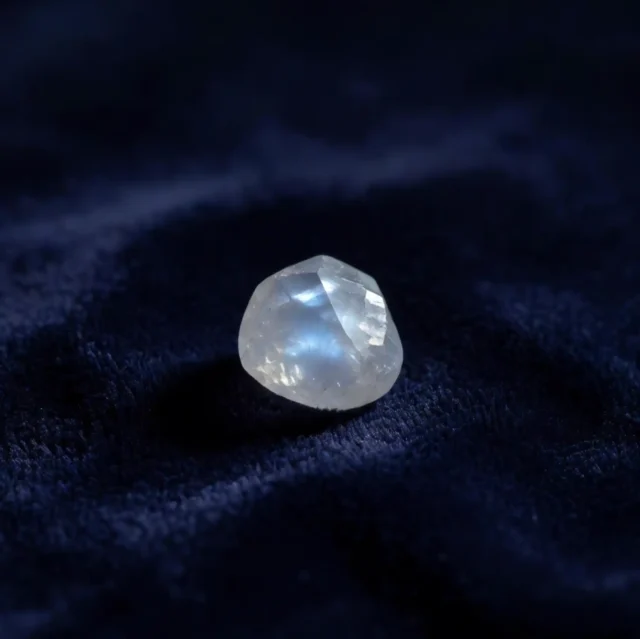
My first moonstone is scratched now. The glow has dulled a bit. I keep meaning to cleanse it properly and I keep not doing it, which probably says something about me. But I pick it up most mornings and tilt it toward the window for a second, and the glow still moves, and something in me still settles a little.
That’s enough for me. Maybe it’ll be enough for you too.
— Gina
GinaStars.com