GinaStars.com
There is a specific kind of suffering that doesn’t respond to the usual things.
Not depression exactly, though it looks like it from the outside. Not grief exactly, though loss is usually involved. Not a breakdown exactly, though things do break. It’s something closer to a dissolution — the specific experience of feeling like who you are is coming apart, and not being able to explain it to anyone, and not being able to find the thing that will fix it because nothing that used to work works anymore.
If you are in this right now, or have been, you already know the quality of it. The flatness. The way things that used to matter stop mattering. The inexplicable sense of being finished with a version of your life before the next version has shown itself. The feeling of being neither here nor there — no longer who you were, not yet whoever comes after.
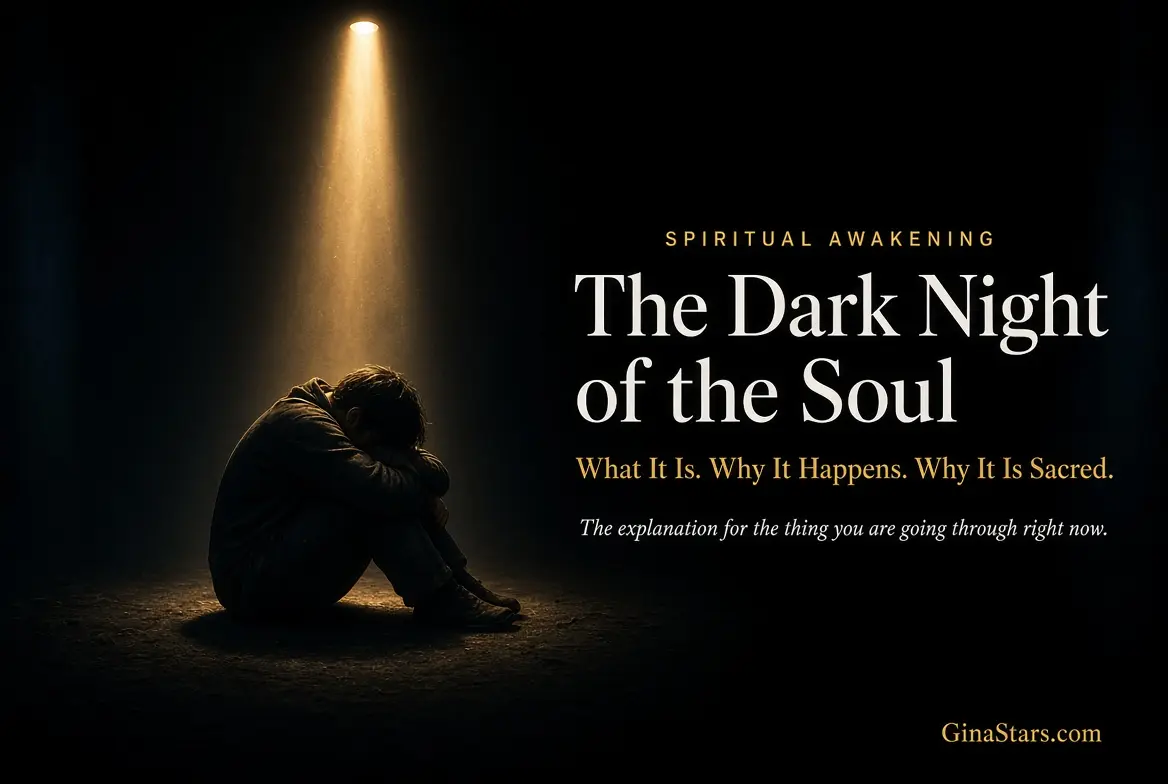
This is the dark night of the soul. It has a name. It has a structure. And understanding both of those things doesn’t make it less hard, but it changes what it means.
The dark night of the soul is not a breakdown. It is a dismantling. The difference is that a breakdown is accidental and a dismantling is, at some level, necessary.
Where the Term Comes From
The phrase comes from a 16th century Spanish mystic named John of the Cross — a Carmelite friar who wrote a poem called Noche Oscura del Alma while imprisoned in a windowless cell by members of his own religious order. The poem describes the soul’s journey through darkness toward union with the divine — not as metaphor, but as lived experience. John knew the territory from the inside.
His description of the dark night has two phases. The first is the purification of the senses — the stripping away of the things that used to bring comfort, meaning, and spiritual consolation. Prayer stops feeling like anything. Ritual feels empty. The practices that once connected a person to something larger simply cease to function. Not because the connection is broken, John argued, but because the soul is being prepared for a different, deeper kind of contact.
The second phase is darker. The purification of the spirit — where even the sense of self begins to dissolve. The person doesn’t just lose access to consolation; they lose the framework that told them who they were. This is the part that most closely matches what people describe today when they use the phrase: the complete destabilization of identity, meaning, and relationship to the world.
John of the Cross was not describing a spiritual setback. He was describing spiritual surgery — the removal of what had to go so something real could take its place.
The term has since moved far beyond its original religious context. Psychologists use it. Philosophers use it. People who have never been near a church use it to describe an experience that transcends whatever framework they’re working in. The reason is simple: the experience is real and it is recognizable, and it doesn’t require a particular belief system to find you.
What It Actually Feels Like
The dark night is not dramatic in the way that crisis usually is. Most people going through it don’t look like they’re going through it from the outside. They function. They go to work. They respond to texts. The dissolution is interior, and the interior of it is very quiet.
What it feels like is an absence. An absence of the things that used to give life its texture. The food that used to bring pleasure doesn’t taste different — you just notice you don’t care whether you eat it or not. The relationships that used to feel necessary feel distant through glass. The work that used to feel meaningful feels like motion without content. The beliefs that organized your sense of who you are and what your life is for have quietly stopped holding.
There is often a period before the person recognizes what’s happening where they try the usual fixes. More sleep. Less alcohol. Exercise. Therapy. A new project. A conversation with someone they trust. None of these are wrong — some are genuinely useful — but none of them address what is actually happening, which is not a problem to be solved but a process to be moved through.
The dark night doesn’t respond to self-improvement because it isn’t caused by anything wrong with you. It is caused by the fact that you are outgrowing something. You can’t optimize your way out of a metamorphosis.
The comparison to metamorphosis is not decorative. Inside a chrysalis, the caterpillar doesn’t develop wings — it dissolves almost entirely into a kind of cellular soup before reorganizing into something new. The dissolution is the mechanism. You cannot skip it and get the butterfly. You cannot rush it and get the butterfly. You move through it and arrive at the other side changed, or you don’t move through it and you don’t.
Why It Happens
The dark night tends to arrive after. After a loss that was larger than expected. After achieving the thing you thought would fix the feeling and discovering it didn’t. After a period of sustained inauthenticity — living a life that looked right from the outside and felt hollow from the inside. After a relationship or a career or a belief system that organized your sense of self has ended or been revealed as insufficient.
What these situations have in common is that they strip away the structure that was holding a particular version of you in place. The version built around the relationship. The version built around the job. The version built around the set of beliefs about how the world worked. When the structure goes, the version of you it was holding goes with it.
This is not failure. It is the natural consequence of growth that has outpaced the container it was held in. You became more than the structure could hold. The structure gave way. The dark night is what happens in the gap between the old structure and the new one — which hasn’t been built yet because you haven’t finished becoming the person who will build it.
The dark night doesn’t happen to people who stopped growing. It happens to people who grew past the version of their life that was built for an earlier version of themselves.
There is also a category of dark nights that seem to arrive without obvious cause — no major loss, no identifiable trigger, just a quiet withdrawal of meaning that accumulates until it becomes impossible to ignore. These are often the most disorienting because there is nothing to point to. Nothing went wrong. Which means you cannot fix the thing that went wrong. Which means you have to sit in the not-knowing longer than feels survivable.
These unprompted dark nights are often the ones that go deepest, because they cannot be attributed to external circumstances and therefore cannot be resolved by changing external circumstances. They require internal change. The kind that doesn’t have a timeline.
Why It Is Sacred
This is the part that’s hardest to hear when you’re in the middle of it.
The dark night is not happening to you. It is happening for you. Not in the toxic-positivity sense where every difficult thing is secretly a gift — some things are just hard and that’s the whole story. But in the specific sense that the dark night is a restructuring. It is removing what cannot survive contact with who you are actually becoming. And what cannot survive that contact was always going to have to go.
The beliefs that dissolve in the dark night are the ones that were never quite true — the ones you inherited, or adopted to survive an earlier version of your life, or built your identity around because you didn’t yet have access to the truer thing. The relationships that don’t survive it were built on a version of you that is finishing. The sense of self that cracks was always a partial self — a self that fit a particular season and can’t fit the next one.
The dark night is sacred not because suffering is good but because this particular suffering is purposeful. It is the cost of genuine transformation — not improvement, transformation.
John of the Cross was clear about this: the darkness is not God’s absence. It is God’s presence in a form the ordinary senses cannot recognize. In secular terms: the dissolution is not the loss of meaning. It is the loss of the meanings that were insufficient. It clears the ground for something more real to grow — something that couldn’t grow in the presence of what was there before.
What comes after the dark night is not the same person repaired. It is a different person — more honest, more genuinely themselves, less dependent on the external structures that used to hold their identity in place. This person is harder to destabilize. They know what they know from the inside rather than from the structure they were living inside of.
That is not a small thing. It is, arguably, the whole point of the process.
What to Do While You Are In It
Not much, honestly. This is the uncomfortable truth about the dark night: it doesn’t respond well to being managed.
What helps is smaller than most people want it to be. Sleep. Water. The people who can sit with you without trying to fix you — this is a specific category and it’s smaller than it sounds. Movement that isn’t punishing. The occasional moment of beauty that gets through the flatness. Patience with the process, extended over and over again in the absence of any visible progress.
What doesn’t help: performing your way through it. Deciding it should be over by now. Comparing your timeline to someone else’s emergence. Trying to manufacture meaning before the genuine kind has had time to form. Filling the void with noise before you’ve had a chance to hear what’s in the quiet.
The dark night asks one thing from you: that you don’t leave before it is finished. Not that you enjoy it. Not that you perform resilience. Just that you stay.
Therapy can help with the symptoms — the depression, the anxiety, the functional difficulties — and is worth pursuing if those are significant. What therapy cannot do is shorten the process itself. The restructuring takes as long as it takes. The most honest thing anyone can tell you is that it does end. Not because suffering has a time limit, but because the transformation eventually completes. The caterpillar does not stay soup forever.
It ends and you are different. Less certain in some ways — the false certainties don’t come back. More solid in others — the things you know from the inside are harder to take from you. And there is something on the other side of it, in the people who have moved through it honestly, that is quieter and less easily shaken than what was there before.
That is not nothing. It is, depending on what was there before, quite a lot.
If You Are in It Right Now
You are not broken. You are not losing your mind. You are not being punished.
You are in the part that doesn’t look like anything yet. The part where the old structure is gone and the new one hasn’t been built. The part that has no name in the language of productivity or achievement or forward motion, because it isn’t any of those things. It is the ground being cleared. It is the caterpillar becoming soup.
It is the most necessary and the most uncomfortable part of becoming who you actually are.
The light is not coming. The light is already there. You are just in the part where you cannot feel it yet — and that is a temporary condition, not a permanent one.
Stay. Not because it is comfortable. Because you are in the middle of something real, and the only way out is through, and through is worth it even though from here you cannot see why.
The dark night ends. What comes after it is more real than what was there before. That is not a promise anyone can make you, because promises about the future aren’t worth much when you’re in the present dark. It’s just what tends to be true for the people who stay.
SHARE THIS with someone going through something they cannot explain right now 🙏🌑✨
— GinaStars.com