GinaStars.com
If you have been tired for most of your life without a clear reason, this might be the explanation you have been looking for.
Not the vague kind of tired that gets better after a good night’s sleep. The specific kind that accumulates — where you do everything you’re supposed to do, work the hours, show up, contribute, keep pace — and still feel like something is being drained from you that never quite refills. The kind where ‘rest more’ has never actually solved it because the problem wasn’t how much you were resting. It was what you were trying to do in the first place.
Projectors make up about 20% of the human population. They are not designed to work the way the other 80% works. And most of them have spent decades trying to anyway.
The exhaustion is not a character flaw. It is what happens when someone lives a strategy that was never built for their body.
What a Projector Actually Is
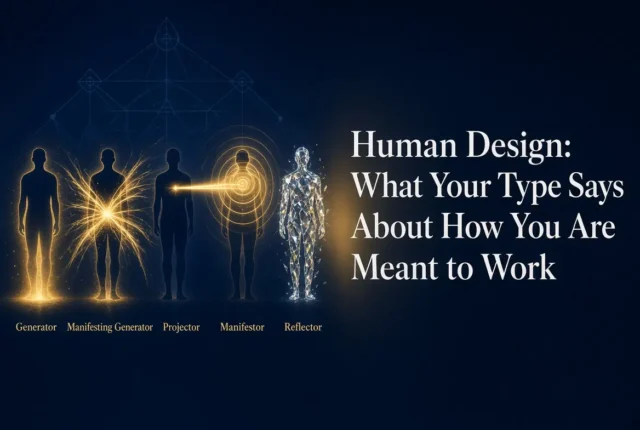
Human Design divides people into five types based on their aura — the energy field that surrounds the body and determines how they interact with the world. The five types are Generators, Manifesting Generators, Manifestors, Projectors, and Reflectors. Each type has a different strategy, a different energy source, and a different relationship to work.
Generators have a defined Sacral center — a motor that runs continuously and generates sustainable life-force energy. When a Generator is doing work they love, the energy replenishes. They are built for sustained output. About 70% of people are Generators or Manifesting Generators. The world’s systems — its workdays, its productivity culture, its expectation of consistent eight-hour output — were built by Generators, for Generators.
Projectors have no defined Sacral center. No motor. Their energy is not self-generated. Instead, they are built to focus on others — to see people clearly, to guide systems, to understand patterns that others miss. Their aura is focused and penetrating rather than enveloping, which is why they can read people with unusual accuracy. But that same aura cannot sustain Generator-level output, because it was not built to.
A Projector trying to work like a Generator is like using a precision instrument to do heavy lifting. The instrument isn’t broken. It’s just being used for the wrong job.
When Projectors absorb and amplify the Sacral energy of others — which they do, naturally, as part of how their aura works — they can feel energized in the moment. At a party, in a meeting, in a session with a client, they may feel capable of doing more than their body can actually sustain. The problem comes when everyone goes home. The borrowed energy leaves. And the Projector is left with nothing to refill from because they don’t have their own motor running.
This is the boom-and-bust cycle that most Projectors know intimately. High energy in social or work contexts, complete depletion after. A productivity spike followed by days of needing to recover. The feeling of being fine and then suddenly not fine, with no obvious external cause.
The Strategy Nobody Told You
Every Human Design type has a strategy — the approach that works with their design rather than against it.
The Generator strategy is to respond: wait for life to present opportunities, respond from the gut, follow the energy that’s generated by the response. The Manifestor strategy is to inform: act on impulses but tell the people it affects before acting, to reduce the resistance that comes when people feel blindsided. The Reflector strategy is to wait a full lunar cycle before making major decisions.
The Projector strategy is to wait for the invitation.
This is the part that gets Projectors in the most trouble when they first encounter it, because it sounds passive. It isn’t. The invitation is not about waiting for permission to exist. It’s about waiting for recognition — the moment when someone sees what you’re capable of and asks for it specifically. A genuine invitation to step into a role, a relationship, a project, a direction.
The difference between a Projector who is thriving and one who is exhausted is usually this: the thriving one stopped trying to initiate and started waiting to be recognized.
When a Projector receives a genuine invitation — when someone who sees them clearly asks for their guidance, their vision, their particular way of seeing — the energy that shows up is different from the borrowed energy of trying to keep pace. It’s sustainable. It comes from being in the right place, doing the right thing, for people who actually want what you’re offering.
When a Projector initiates without invitation — jumps into systems uninvited, offers guidance that wasn’t asked for, tries to stay pace with Generator energy because that’s what the environment expects — they meet resistance. The resistance is not personal. It is the friction of a design operating outside its strategy. And the exhaustion that follows is the cost of that friction, compounded over years.
The Not-Self Theme
Every Human Design type has a not-self theme — the emotional state that signals you are living out of alignment with your design.
For Projectors, it’s bitterness.
Not the dramatic kind. The quiet, accumulated kind — the feeling of working hard and not being seen for it, of offering guidance that gets ignored or taken without credit, of watching Generators advance through sustained output while you fall behind despite knowing things they don’t. The sense that the game is rigged, that the systems aren’t built for how you operate, that something about the way the world works keeps not working for you.
That bitterness is accurate information. The systems are not built for Projectors. But the solution is not to push harder against systems that weren’t designed for your type. It’s to find the invitations — the specific contexts, people, and environments where what you uniquely offer is recognized and wanted.
Bitterness in a Projector is not a personality problem. It is a signal. It means they have been operating without recognition for too long.
The signature of the Projector in alignment is success — not in the hustle-culture sense, but in the sense of being genuinely seen and valued for what they are actually good at. When a Projector is invited into the right role, they are often the most effective person in the room. Not because they work the hardest, but because they see the most clearly.
What Rest Actually Means for a Projector
This is the part that takes the longest to accept.
Projectors need more rest than any other type except Reflectors. Not rest as recovery so they can get back to output — rest as a legitimate and necessary part of how their design functions. The Projector body is not built for sustained production. It’s built for focused, penetrating insight, in the right context, with adequate recovery between.
In practice, this means: not filling every hour. Napping without guilt. Knowing that the two-hour window of genuine clarity is worth more than the eight-hour day of grinding. Protecting the energy that’s actually available rather than borrowing against tomorrow’s.
Most Projectors have spent years being told, implicitly or explicitly, that this is laziness. That they need to push through, keep pace, stop making excuses. The people saying this are almost always Generators who genuinely don’t understand that their energy works differently — not because they’re unkind, but because their body’s experience is their reference point.
A Projector resting is not failing to work. They are maintaining the instrument. The clarity that comes from genuine rest is what makes their work valuable in the first place.
The practical question for most Projectors is not ‘how do I get more energy’ but ‘where am I spending energy I don’t have?’ The answer is usually: trying to initiate without invitation, trying to sustain Generator-level output, staying in environments or relationships where their specific gifts aren’t recognized.
Remove those and the exhaustion doesn’t disappear entirely — Projectors are always going to need more recovery than Generators — but it becomes manageable. It stops being the baseline condition of every day and starts being the natural response to genuine output, which can then be followed by genuine rest.
The Projector Gift
None of this is about limitation. The Projector design is not a lesser version of the Generator design — it’s a different design with different strengths.
Projectors see systems. They see what’s working and what isn’t. They see people clearly — sometimes more clearly than those people see themselves. They have a natural capacity for strategy, for guidance, for the overview that the people inside the system can’t access because they’re too close to it.
The leaders, guides, teachers, coaches, therapists, and strategists who consistently produce work that changes how people think about themselves and their situations — a disproportionate number of them are Projectors. Not because they work the hardest. Because they see the most clearly.
The Projector’s job is not to do more. It is to see what others can’t, wait for the right invitation, and then say the precise thing that changes how the whole system works.
If you are a Projector reading this and recognizing yourself in the exhaustion — the boom and bust, the bitterness that accumulated quietly, the sense that you’ve been trying to fit into a shape that was never yours — this is the reframe: you were not failing to keep up. You were using the wrong strategy in the wrong conditions.
The right conditions exist. The invitations exist. The people who will recognize what you see and ask for it specifically — they exist. The work is not pushing harder. It’s stopping pushing long enough to be found by the right thing.
That is a different kind of hard. But it is the kind that produces success that actually lasts, in a body that actually recovers, doing work that actually fits.
SHARE THIS with every Projector who has been calling their exhaustion laziness 🦋📛
— GinaStars.com