GinaStars.com
Most people come to Human Design looking for their type. Generator, Projector, Manifestor, Reflector — that part gets all the attention. But the 9 centers are where the real information lives. They tell you which parts of your energy are consistent and which ones are wide open to outside influence. That difference matters more than most people realize, and once you understand it, you start reading your own behavior in a completely different way.
A defined center — one that’s colored in on your chart — operates from a reliable, steady energy. It’s always on. A defined Sacral means you have consistent life-force energy and can sustain work over time. A defined Will means you have consistent access to willpower and can make commitments and keep them without running on empty.
An undefined center — white or open on your chart — works differently. It amplifies and reflects whatever energy comes into it from outside. This isn’t a weakness. It’s actually a source of wisdom when you understand what’s happening. The trouble is that most people with undefined centers spend their lives trying to be consistent in areas where they were never designed to be consistent.
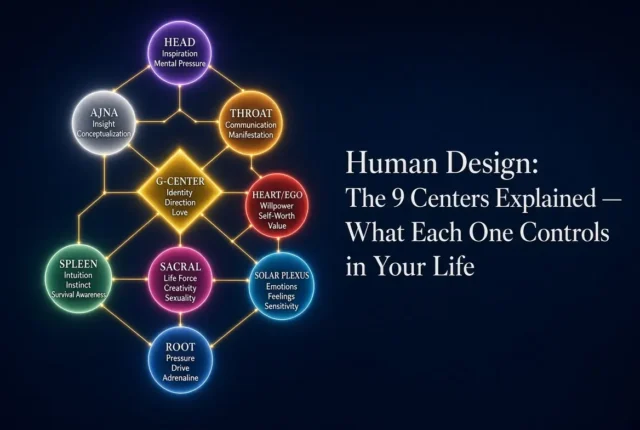
Here’s what each of the 9 centers actually governs.
The Head Center
Located at the top of the chart, the Head Center is the pressure center for inspiration and mental questioning. When it’s defined, you have a consistent source of mental pressure — questions, curiosity, a drive to figure things out. When it’s undefined, you pick up inspiration and mental pressure from everyone around you. The classic pattern with an undefined Head is spending enormous energy thinking about questions that aren’t actually yours to answer. You feel the pressure as if it’s urgent and real. It usually isn’t.
If your Head is undefined: before you spiral into researching something for three hours, ask yourself — did I actually care about this before I walked into that room?
The Head Center feeds directly into the Ajna below it. Ideas that start as pressure in the Head get processed as concepts in the Ajna. When both are defined, there’s a consistent mental machine running. When neither is defined, your mental landscape is highly variable — and that’s fine, as long as you’re not trying to force it into consistency.
The Ajna Center
The Ajna sits just below the Head and handles conceptual processing — how you form opinions, analyze, and make sense of things. A defined Ajna thinks in reliable, consistent ways. The same mental frameworks apply across situations. There’s a certain confidence in having a defined Ajna, because your perspective doesn’t shift much based on who you’re talking to.
An undefined Ajna is more flexible — almost too flexible. You can genuinely see multiple sides of an argument and hold several contradictory perspectives at once. This makes you adaptable and often quite good at understanding other people. The downside is that it can feel impossible to commit to a position, because you can always see why the other view also makes sense.
The undefined Ajna isn’t designed to be certain. Trying to force certainty there creates the kind of anxiety that never fully resolves.
The Ajna connects down to the Throat Center, which is where mental processing gets expressed outwardly as communication. A lot of what people experience as “I don’t know how to say what I think” is actually an Ajna-Throat connection issue, not a lack of clarity.
The Throat Center
The Throat is the center of manifestation and communication. Everything in Human Design eventually moves toward the Throat — it’s the output center for the entire system. Speaking, acting, creating, making things happen in the world: all of it routes through here.
A defined Throat has a consistent voice and a consistent way of taking action. People with defined Throats often find that speaking comes naturally — they have things to say and a way of saying them that doesn’t change much based on context. When the Throat is connected to a motor center (the Will, Solar Plexus, Sacral, or Root), that person has the capacity to initiate directly. This is where Manifestors tend to land — defined Throat connected to a motor.
An undefined Throat is a different experience. The voice isn’t consistent. Sometimes it flows, sometimes it doesn’t. Speaking in groups can feel unpredictable. The undefined Throat is also the source of that familiar pressure to speak before you’re ready — to fill silence, to announce things prematurely, to say something just to prove you’re present.
Undefined Throat people often do their best communicating one-on-one, when the energy is simpler and they’re not absorbing everyone else’s need to speak.
The G Center
The G Center — also called the Self Center or Identity Center — sits in the middle of the chart and governs love, direction, and identity. This is where your sense of self lives, along with your sense of where you’re going in life.
A defined G has a stable, consistent sense of identity. Who they are doesn’t change much based on environment or the people around them. They have an internal compass pointing in a relatively fixed direction. This can look like confidence from the outside, but it’s less about attitude and more about having a built-in orientation.
An undefined G is one of the most profound open centers in the chart. People with it can genuinely take on the identity of the environments they move through. Walk into a room of artists and feel like an artist. Spend time with entrepreneurs and start thinking like one. This isn’t fake — it’s the undefined G doing what it’s designed to do: sampling the full range of what identity and direction can look like.
The challenge is that undefined G people often search for a fixed identity they were never meant to have. The direction for them comes from following what feels good in the body — and trusting that the path reveals itself one environment at a time.
The Will Center
The Will Center (also called the Heart or Ego Center) governs willpower, self-worth, resources, and commitments. It’s a motor center, meaning it generates energy — specifically the energy to push through, to compete, to make promises and keep them.
Defined Will people have consistent access to willpower. They can commit and follow through without depleting themselves. They’re also usually comfortable talking about money, value, and what they deserve — the Will Center rules all of that.
An undefined Will is where a lot of people create serious problems for themselves. They make commitments from a moment of high energy — borrowed from someone with a defined Will — and then can’t sustain them. The willpower just isn’t there the next day. This isn’t a character flaw. The undefined Will isn’t designed to be consistently strong. It’s designed to dip in and out of willpower depending on who it’s around.
Undefined Will people: stop making promises in the moment. Sleep on commitments. Your yes tomorrow, when you’re not in someone else’s energy, is the only yes that actually counts.
The Will Center also connects to self-worth in a direct way. An undefined Will that hasn’t been understood tends to collect a lot of evidence that it’s not valuable enough, not capable enough, not worthy of asking for what it wants.
The Solar Plexus Center
The Solar Plexus is the emotional center, and it’s the most powerful motor in the chart when it’s defined. About 50% of people have a defined Solar Plexus, which means they operate on an emotional wave — moving through highs and lows on a rhythm that isn’t caused by external events. The wave just moves. The clarity for defined Solar Plexus people comes with time, after riding the wave. Acting from the peak of excitement or the depth of pain both tend to produce decisions they regret.
An undefined Solar Plexus amplifies the emotional energy of everyone nearby. Walk into a room of anxious people and become anxious. Sit next to someone grieving and feel it as if it’s yours. The undefined Solar Plexus is often described as the empath’s signature in the chart.
The key question for an undefined Solar Plexus is: is this emotion actually mine? Nine times out of ten, especially in groups or after difficult conversations, the answer is no.
The Solar Plexus also connects to intuition in ways that aren’t always obvious. Emotional clarity, when it’s waited for, is some of the deepest wisdom available in the chart.
The Sacral Center
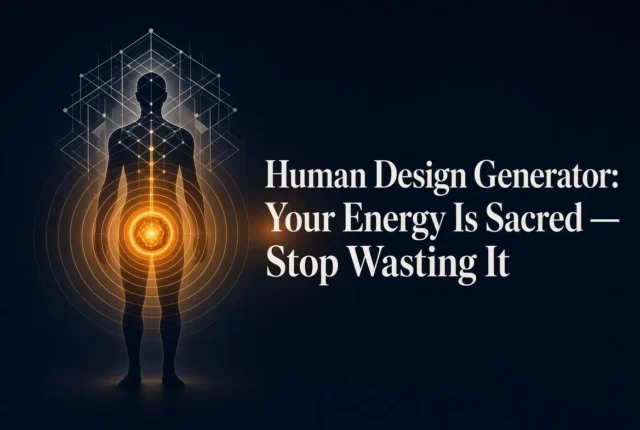
The Sacral is the life-force center — the engine of work, creativity, sexuality, and sustained energy. It’s only present in Generators and Manifesting Generators (about 70% of the population). If you have a defined Sacral, you have a renewable energy source. You can work, and keep working, and come back the next day ready to work again — but only on things that genuinely light you up.
The Sacral responds. It doesn’t initiate. The classic Sacral response is a gut sound — an “uh-huh” for yes, an “unh-uh” for no — that rises before the mind has time to think. This is the authority for most Generators, and learning to trust it over the mental second-guessing is the central work of the Generator’s life.
An undefined Sacral means you don’t have consistent access to that life-force energy. Projectors, Manifestors, and Reflectors all have open Sacrals. They can take in Sacral energy from Generators around them, amplify it, and run on it for a while — but they cannot sustain it indefinitely. Rest isn’t optional for open Sacral types. It’s mechanical.
If you have an undefined Sacral and you’re exhausted, you didn’t fail at energy management. You pushed past what your design can actually sustain.
The Spleen Center
The Spleen is the oldest awareness center in the chart — it operates in the now, in the body, in the moment. It governs intuition, survival instincts, immune system, and fear. When it’s defined, there’s a consistent, quiet voice that knows things without knowing how it knows them. The Splenic voice is soft and it doesn’t repeat itself. It speaks once. If you don’t listen, it’s gone.
An undefined Spleen picks up on the wellbeing and survival signals of everyone nearby. Open Spleen people often stay in situations that aren’t good for them because the Splenic energy of the other person makes them feel safe — temporarily. The undefined Spleen is also prone to holding on: to things, to people, to situations that have run their course.
The undefined Spleen’s question: am I staying here because it’s right for me, or because being near this person makes me feel okay?
The Root Center
The Root Center is the pressure center at the base of the chart. It generates adrenaline pressure — the drive to get things done, to move, to complete, to relieve the pressure. When it’s defined, the pressure is consistent and manageable. There’s a rhythm to work and rest that comes naturally.
An undefined Root absorbs the adrenaline pressure of everyone around it and amplifies it. The result is often a chronic feeling of being behind, needing to rush, needing to finish everything right now so the pressure will stop. The problem is that it never stops, because the pressure isn’t coming from inside — it’s coming from the environment, and the environment keeps generating more.
If you have an undefined Root, the pressure you’re feeling right now to hurry up is almost certainly not yours. It can wait.
The Root feeds energy up through the Sacral (in Generators) and into the rest of the system. It’s the ignition. Understanding whether your ignition is consistent or responsive to outside conditions changes how you approach deadlines, urgency, and the whole concept of productivity.
SHARE THIS
GinaStars.com