GinaStars.com
The question comes up constantly in spiritual communities, and I get why — both practices involve intention, both involve asking for something to change, and both have dedicated followers who swear by them. But treating spells and manifestation as the same thing, or assuming one is just a more mystical version of the other, misses what each one actually is and what it actually does.
They are different tools. They work differently. And whether one is more powerful than the other depends entirely on what you are trying to do.
The debate between spells and manifestation is mostly a debate between people who have not clearly defined either term. Once you actually define them, the comparison becomes more interesting and the answer less obvious.
What Manifestation Actually Is
Manifestation, in its practical form, is the directed use of attention, belief, and emotion to bring specific outcomes into physical reality. The underlying theory — drawn from New Thought philosophy in the 19th century, popularized through books like Napoleon Hill’s Think and Grow Rich (1937) and much later through The Secret (2006) — is that focused conscious thought influences what materializes in a person’s life.
The mechanism proposed is the law of attraction: like attracts like, meaning the frequency of your thoughts and feelings draws experiences of a matching frequency toward you. Whether you understand this literally as quantum physics (a claim that actual physicists generally push back on) or metaphorically as a psychological truth about how attention shapes behavior, which then shapes outcomes, depends on your framework.
Manifestation as a practice typically involves: clarifying what you want, visualizing it as already real, generating the emotional state of already having it, taking inspired action toward it, and releasing attachment to how it arrives. The 369 method, vision boards, scripting, and affirmations are all manifestation techniques — different structures for doing the same basic thing.
Manifestation works primarily through the mind. It changes what you think, what you notice, and therefore what you do. The outcomes it produces tend to be logical extensions of changed behavior and perception.
What a Spell Actually Is
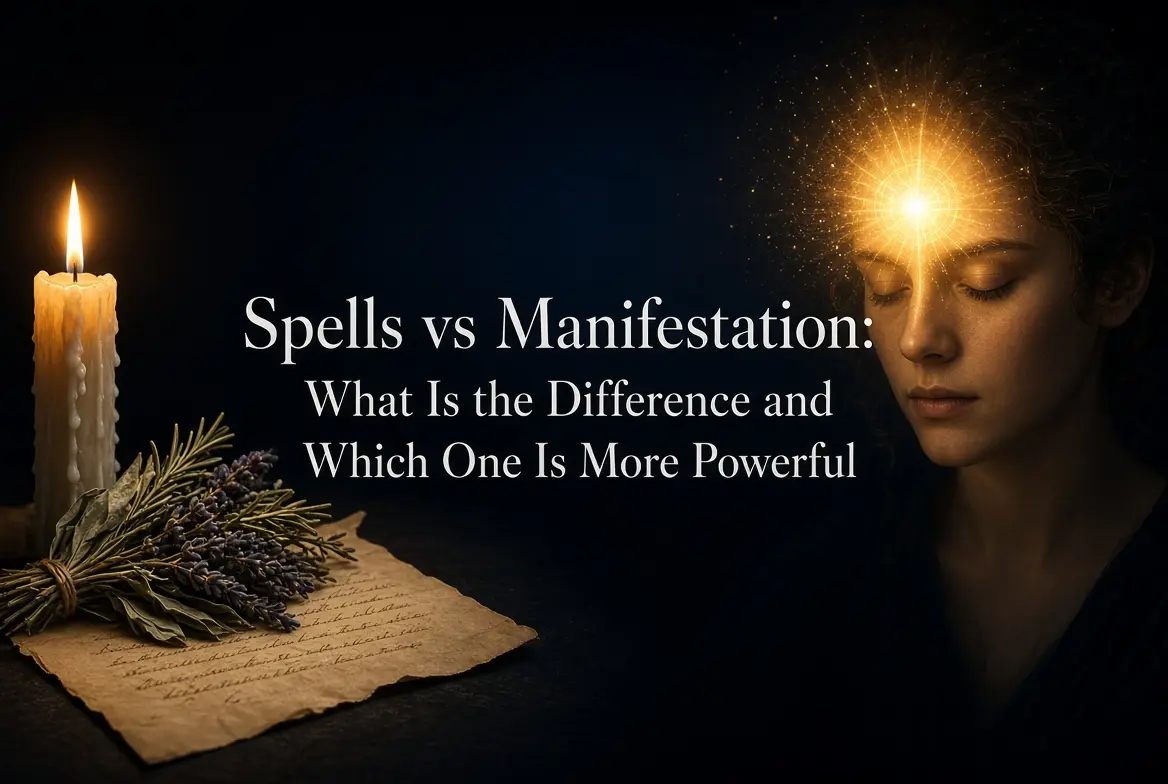
A spell is a ritual act — typically involving physical components like candles, herbs, written intentions, or symbolic objects — designed to direct energy toward a specific outcome. Spellwork comes from folk magic traditions that predate modern spiritual practice by millennia. Wicca, hoodoo, folk witchcraft, ceremonial magic, and dozens of other traditions each have their own systems, but the core structure is similar: physical action performed with focused intent, often aligned with specific timing (moon phases, days of the week, planetary hours), uses the physical as a bridge to the non-physical.
A spell is not a prayer, though prayer shares some structural elements. Prayer is typically directed toward a deity with the understanding that the outcome is the deity’s to grant or withhold. A spell, in most traditions, is the practitioner directing energy themselves — the spell is the mechanism, not a request.
The physical components of a spell matter because they engage multiple senses and create a ritualized state of consciousness in the practitioner. The smell of the herbs, the flame of the candle, the texture of the paper being burned — all of these pull the practitioner’s full attention into the act in a way that simply thinking about an outcome does not.
A spell externalizes intention into physical action. It makes the intention real in the material world before the outcome has arrived, which is a different psychological — and possibly energetic — process from holding an intention in the mind.
The Real Difference
Manifestation is primarily internal. It works through changing your mental and emotional state, which changes your perception, which changes your behavior. The outcomes it produces are traceable — you can usually see the chain of cause and effect, even if some of the links are subtle.
Spells are primarily relational — between the practitioner and the energy of the material world, between intention and physical action, between timing and outcome. They work through a combination of psychological depth (the ritual creates a state of full concentration and commitment) and, depending on your beliefs, through direct energetic influence on reality.
The practical difference shows up most clearly in what each one requires. Manifestation requires sustained mental practice — weeks or months of consistently holding a belief and emotional state. A spell can be performed in an evening and considered complete.
The sustained nature of manifestation is both its limitation and its strength. The limitation: most people cannot maintain the required mental state consistently enough to produce results quickly. The strength: when it works, it produces lasting change because the internal state that produced the result has actually shifted.
A spell, conversely, can produce faster results in specific situations, particularly around timing-sensitive needs or outcomes that require a single point of concentrated intent. But a spell performed without any shift in the underlying belief or emotional frequency is working against headwinds. The energy the practitioner sends out is met by the energy of their own doubt or resistance.
The most effective approach is neither pure manifestation nor pure spellwork. It is the internal alignment of manifestation combined with the concentrated physical act of spellwork. The spell that lands hardest is the one performed by someone who already genuinely believes in the outcome.
Which One Is More Powerful
The honest answer: it depends on what you mean by power.
If power means speed, a well-constructed spell in the hands of a practiced witch with genuine belief behind it can produce results faster than manifestation techniques that rely on slowly shifting a belief pattern over weeks. The focused concentrated act of a spell, aligned with moon timing and performed with full conviction, puts a lot of energy into a specific direction in a short time.
If power means lasting change, manifestation has the edge. The internal shift that consistent manifestation practice produces — the genuine change in what you believe is possible and what you therefore pursue — tends to create more durable outcomes because the person themselves has changed.
If power means reliability, neither is particularly reliable in the hands of someone who is new to the practice, inconsistent, or working against strong underlying resistance. Both practices produce the most consistent results for people who have done enough internal work to reduce the gap between what they consciously want and what they unconsciously believe is available to them.
I think the question ‘which is more powerful’ is actually the wrong question. The more useful question is: what does this situation call for? A specific, time-sensitive, concrete need might call for a spell. A long-term shift in circumstances that requires a genuine change in who you are and what you believe is possible might call for sustained manifestation work. Using both — the ritual to create a concentrated point of energy, the sustained practice to keep the frequency aligned — is what the most experienced practitioners tend to do.
Power in spiritual practice is not in the technique. It is in the alignment between what you are doing and what you actually believe. A half-hearted spell from someone who thinks it is silly produces nothing. A morning practice from someone who genuinely believes their thoughts are shaping their reality produces results that are hard to argue with.
What to Use When
Use a spell for: specific concrete needs with a clear timeframe, situations requiring a concentrated burst of energy, times when you want to mark an intention with physical action, moon phase work, and situations where the ritualized act of doing something helps make the intention real to you.
Use manifestation for: long-term life direction, shifting beliefs about what is possible for you, building a sustained relationship with abundance or love or success, and any situation where the outcome depends as much on who you are becoming as on external circumstances.
Use both for: anything that genuinely matters to you, because the combination of the internal sustained practice and the external ritualized act tends to produce better results than either alone.
And be honest with yourself about the resistance underneath. No technique, however correctly performed, consistently overcomes a deep belief that you do not deserve the thing you are asking for. The work on that belief is the foundation that both spells and manifestation are built on.
SHARE THIS with someone who cannot decide between spells and manifestation 🕎✨
— GinaStars.com