GinaStars.com
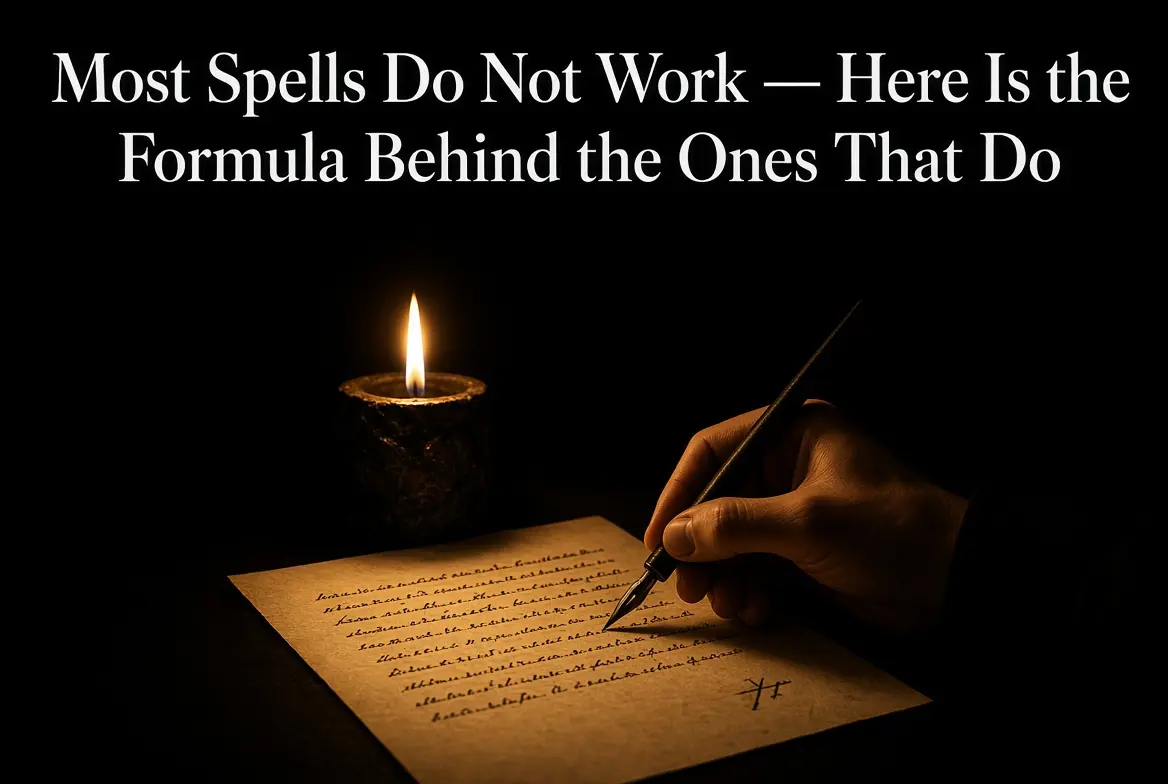
Most spells that do not work fail for the same reason: the person performing them put the effort into the external components — the candle color, the herb selection, the moon phase timing — and almost no effort into the internal state they brought to the working. The external components of a spell are a container. A container holds nothing if there is nothing inside it.
This article is about the internal formula — the specific sequence of internal states that determines whether a spell produces results or simply produces an elaborate ritual with no effect. You can apply this formula to any spell, including ones you create yourself. The formula is what makes the spell. The ingredients are secondary.
A well-constructed spell from your own life and your own need, performed in the correct internal state, will outperform a historically documented spell performed mechanically with all the correct ingredients. Every time. The internal state is the magic.
What a Spell Actually Is
Before the formula, a definition worth having. A spell is a deliberate act — typically ritualized, often involving physical components — through which a practitioner directs focused intention toward a specific outcome. The ritual structure serves two purposes: it creates a container that separates this activity from ordinary activity (which allows the mind to enter a different state), and it engages the body through sensory experience in a way that deepens the quality of the intention.
The outcome of a spell is not produced by the candle or the herb. It is produced by the state of focused intention the ritual creates in the practitioner. The candle and the herb help create that state. They are not the active ingredient.
This is a useful reframe for people who have tried spells and found them ineffective. The question to ask is not ‘did I use the right color candle?’ It is ‘was I genuinely present, in a clear and focused state, with a specific real intention, when I performed this?’ In most cases where spells fail, the answer to that question is no.
The Formula
Step 1: Clarity of intention — before anything else
Before you choose a candle color, a moon phase, or any other component, you need an intention that is specific enough to produce a genuine emotional response when you hold it. ‘I want more money’ does not do this. ‘I receive the income that allows me to pay my rent comfortably and have something left over’ does. ‘I want love’ does not produce a real feeling. ‘I am in a relationship where I feel genuinely chosen and safe, where I do not have to shrink to be acceptable’ produces something real.
The specificity is not about limiting what can arrive. It is about creating an intention that your emotional system can actually engage with. Vague intentions produce vague emotional engagement, which produces vague results.
Write the intention down before you begin the spell. This forces the specificity. If you cannot write it clearly, you do not yet know what you actually want, and the spell will reflect that.
Step 2: The correct internal state
This is the step that determines everything else. The internal state you bring to a spell is not about mood — it is about whether you are genuinely open to receiving what you are asking for, or whether there is a part of you that believes it is not available or that you do not deserve it.
The test is simple: hold your written intention and notice what happens in your body. If there is opening, warmth, a sense of possibility — that is the right state. If there is tightening, skepticism, a sense of ‘but it probably won’t happen’ — you are not in the right state yet. The second state is not a character flaw. It is information about where the internal resistance is. You need to address that resistance before the spell will work.
Addressing it does not require resolving it completely. What it requires is being honest about it. Name the resistance out loud: ‘Part of me does not believe this is available.’ Then consciously choose to proceed anyway, from the clearest state of genuine intention you can access. Even a partial opening is better than a performative positivity that papers over the resistance.
Step 3: The physical anchor
This is where the candle, the herb, the written intention, or whatever physical component you choose becomes relevant. The physical anchor serves to pull the mind fully into the present moment of the spell — to give the senses something specific to engage with that signals ‘this activity is different from ordinary activity.’
Choose a physical anchor that genuinely resonates with your intention. Green for money and growth, pink or red for love, white for clarity and new beginnings, gold for abundance and prosperity. Herbs that carry the right association: rosemary for mental clarity, rose for love, cinnamon for money, lavender for peace. These associations are not arbitrary — they carry centuries of accumulated intentional use that adds weight to their symbolic function.
Write your intention on paper and incorporate it into the spell — burn it, fold it and place it beneath the candle, bury it. The physical act of doing something with the written intention completes the loop between the internal state and the external world.
Step 4: The focused act
Light the candle. Say the intention out loud — not in your head. The vocalization activates different systems than internal reading and produces a different quality of commitment. Say it three times if that feels right, or once with genuine weight. What matters is that when you say it, you are actually saying it — not performing saying it.
Hold the focus for as long as the state stays genuine. This might be two minutes. It might be fifteen. When your mind starts to wander to what you are having for dinner, the spell is complete for this session.
Step 5: The release
Close the working with a statement of release: ‘This is done. I trust the process.’ Then actually release it — do not spend the rest of the day monitoring whether it worked. The monitoring energy is the opposite of the trust state the spell requires. The most effective practitioners do a spell and then genuinely forget about it, trusting that what was sent out is working.
This is harder than it sounds. The releasing is itself a practice in trust — in the belief that you do not have to chase what you have set in motion. If you cannot do the releasing, that is information about the same resistance the internal state check revealed.
Creating Your Own Spell
With this formula, creating your own spell is straightforward. You need: a specific written intention, a physical anchor that resonates with that intention, a space and time where you will not be interrupted, and a way to close the working. That is the whole structure.
The moon phase timing, the day of the week associations, the specific herbs and colors — all of these add depth and are worth learning over time. But they are refinements of the basic formula, not prerequisites for it. A spell performed with none of these refinements but with genuine clarity, genuine internal state, and genuine release will produce results. A spell performed with every refinement but without those qualities will not.
Start with the internal formula. Add the external refinements as you learn what resonates with you. Your own intuition about what components feel right for a specific intention is often more accurate than following a prescribed recipe for a generic version of the same intention.
The most powerful spell you can perform is the one you wrote yourself, for your own specific need, in your own words, with your own chosen components, in a state of genuine intention and genuine trust. That combination is not available in any grimoire. It is only available in you.
SHARE THIS with someone who wants to try spell work but does not know where to start 🕯✨
— GinaStars.com