GinaStars.com
Most people discover Human Design and immediately go looking for personality traits. They want to know if they are supposed to be a leader, an introvert, a creative. That is not really what Human Design tells you.
What it actually tells you is more specific and, honestly, more useful: it tells you how you are designed to interact with energy. How you generate it, how you spend it, how you restore it, and what happens to your body when you violate those mechanics. The personality stuff is secondary. The energy mechanics are the point.
Human Design was developed by Ra Uru Hu — born Alan Robert Krakower — in 1987 following what he described as a mystical experience in Ibiza. He synthesized the I Ching, the Kabbalah’s Tree of Life, the Hindu-Brahmin chakra system, and quantum physics into a system built around a birth chart called the body graph. Whether you approach this as metaphysics or as a practical personality framework, the categories it produces are specific enough to be genuinely useful.
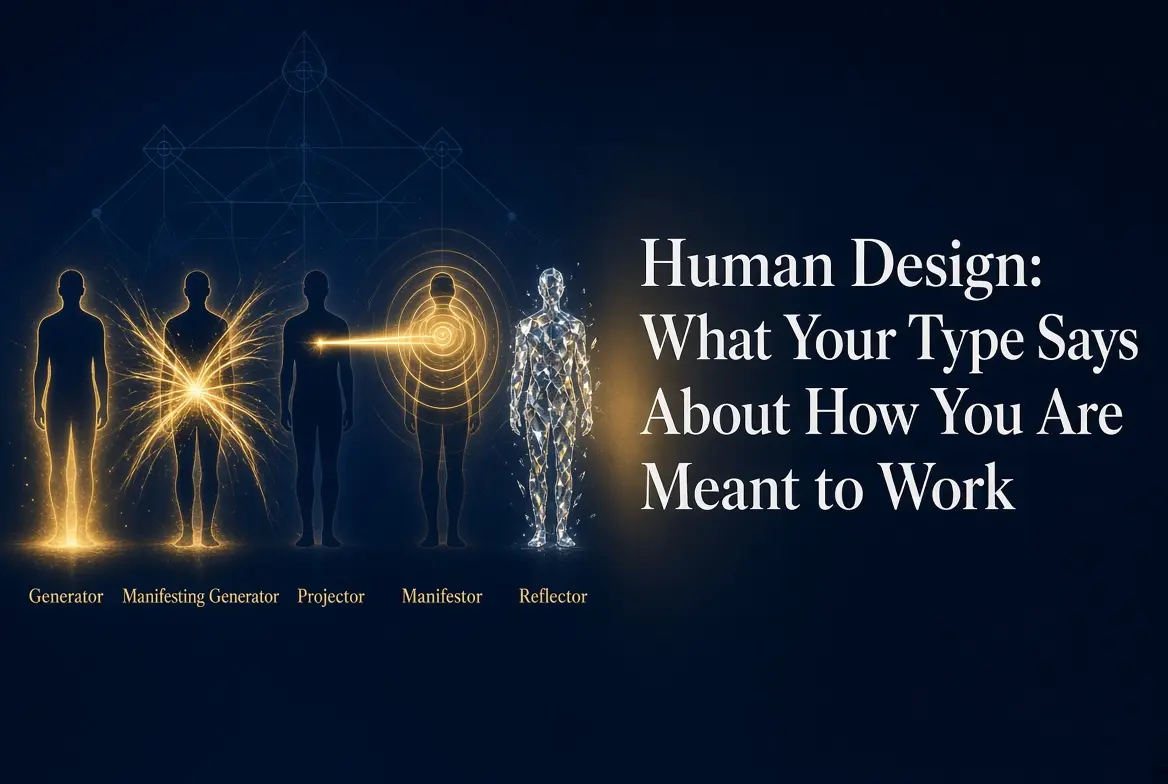
There are five types. Each one works differently. Most people have spent their entire lives operating as if they were a different type, which is why the exhaustion, the frustration, the sense of pushing uphill, is so consistent.
The system does not ask you to become someone different. It asks whether the person you have been trying to be actually matches how you are built.
How to Find Your Type
You need your exact birth date, birth time, and birth location. Go to mybodygraph.com or jovianarchive.com, enter the information, and your chart generates instantly. Your type appears at the top. It will say Generator, Manifesting Generator, Projector, Manifestor, or Reflector.
If you do not know your birth time, your type is still findable in most cases — it is determined by the definition of specific centers in the chart, and most types can be confirmed from birth date and location alone. The exception is if your chart falls on a cusp day. If you get an ambiguous result, the birth certificate is worth tracking down.
Once you have your type, read this. Then read it again in six months when you have had time to test it against your actual life.
The Five Types
Generator — 37% of the population
Generators have a defined Sacral center — a specific energy center in the lower body that generates consistent, renewable life force. The Sacral is a motor. It runs continuously. And it has a particular quality that no other center has: it produces an almost involuntary response to things in the environment, a gut sound that signals yes or no before the mind has time to reason its way to an answer.
The Generator’s strategy is to respond. Not to initiate, not to plan out what they want and then go pursue it, but to engage with life as it comes and notice what produces energy and what drains it. When a Generator responds from the Sacral to something that genuinely lights them up, the motor engages and they can work at that thing for hours without depleting. When they force themselves toward something the Sacral is not responding to — even something that makes rational sense — the exhaustion comes fast and stays long.
The trap for Generators is initiating. Most of us are raised in a culture that tells us to go out and make things happen, to decide what we want and pursue it. For Generators, this is backwards. The things that are correct for them show up. The Sacral responds. They follow the response. This sounds passive but it produces a very different kind of life from the one you get by pushing.
A Generator in alignment ends most days tired in a satisfying way — the tiredness of a body that has used its energy on the right things. A Generator out of alignment ends most days frustrated, wondering why they work so hard and feel so empty.
Frustration is the Generator’s not-self theme — the emotional signal that they have been operating against their strategy. If frustration is a recurring state, the question worth sitting with is: what have I been initiating that the Sacral never actually agreed to?
Manifesting Generator — 33% of the population
Manifesting Generators have the Sacral motor of the Generator and additionally have a connection from a motor center to the Throat center, which gives them a quality of being able to move fast and skip steps that feel unnecessary to them. They are multi-passionate, multi-directional, and often labeled scattered or unfocused by people who do not understand why they operate that way.
The MG strategy is to respond and then inform before acting. Like the Generator, they wait for the Sacral response — they do not initiate from scratch. Unlike the pure Generator, they move faster once the response comes. They are built to jump to step three when steps one and two feel redundant. The catch is that skipping steps in relationships and projects sometimes creates confusion for the people around them, which is why informing — telling the relevant people what is happening before it happens — is part of the strategy.
The not-self theme for MGs is anger and frustration simultaneously. Anger tends to come from feeling controlled or required to slow down for no reason they can identify. Frustration comes when they have been forcing rather than responding.
Manifesting Generators are not doing too many things because they lack discipline. They are doing too many things because they are responding to multiple genuine Sacral yeses. The problem is not the quantity. It is whether each one has a real response behind it.
Projector — 20% of the population
Projectors do not have a defined Sacral center. No motor. Their energy is not self-generated in the way Generator energy is — it is focused and directed rather than produced. Projectors are built to read systems, to see people clearly, to understand what is happening and to guide accordingly. Their aura is penetrating and focused rather than enveloping, which is why they can see things about people and situations that those people and situations cannot see about themselves.
The Projector strategy is to wait for the invitation before offering guidance or entering major new chapters — relationships, careers, places to live. This is probably the most misunderstood strategy in Human Design because it sounds like being passive, or like waiting for someone else to give you permission to have a life. It is not that. It is the recognition that when a Projector jumps into situations without being invited, they meet resistance — not always visible resistance, but friction. Their insights get dismissed. Their guidance goes unheard. The invitation is not permission. It is the signal that the environment is ready to receive what they have.
The not-self theme for Projectors is bitterness. The bitterness of being overlooked, of offering what you can see and having it ignored, of working hard at Generator speed and still not being seen the way Generators get seen. If bitterness is familiar, the question is: how many of the things I am in did I initiate without being invited?
A Projector who has been invited into the right role, by the right person, at the right time, is frequently the most effective person in the room. Not because they work the hardest. Because they see the most clearly.
Manifestor — 9% of the population
Manifestors are the only type that does not need to wait. They have a motor connected to the Throat center, which means they can initiate — can begin things, start movements, impact the people around them — without a specific trigger. This is rare. It is also why Manifestors have historically been the people who start things that others then sustain.
The Manifestor strategy is to inform. Not to ask permission, not to explain their reasoning, but to tell the people who will be affected by their actions what is happening before it happens. This sounds simple. In practice, Manifestors often resist it because they are built to move fast and independently, and having to loop people in feels like a delay. But the resistance that Manifestors attract when they do not inform is real — people feel blindsided, they react, they create friction. The informing removes most of that friction without removing the independence.
The not-self theme for Manifestors is anger. Specifically the anger that comes from feeling controlled, monitored, or required to justify their movements to people who have no business directing them. When a Manifestor is consistently angry, the question is usually about whether they are informing, and whether they have found environments that allow them to function the way they are built to.
Manifestors are not difficult. They are built to initiate in a world that is mostly built for responding. The friction is structural, not personal.
Reflector — 1% of the population
Reflectors have no defined centers. None. Every center in their body graph is open, which means they sample and amplify the energies of everyone around them, and they reflect back to the communities they are part of what those communities actually are. A healthy community has healthy Reflectors. A sick community has sick Reflectors.
The Reflector strategy is to wait a full lunar cycle — 28 to 29 days — before making major decisions. This is because the moon moves through the entire Human Design wheel in that time, activating each of their open centers in sequence. By the end of a lunar cycle, a Reflector has had access to every frequency and can make a decision that has been informed by the full range of what is available rather than by whatever energy was dominant the day the decision came up.
Reflectors are the rarest type for a reason — most people’s nervous systems cannot handle the permeability they experience without significant support and understanding. The ones who are living correctly tend to have a kind of wisdom about people and places that is genuinely unusual. They have been sampling the full spectrum for their entire lives. That is not nothing.
Reflectors are not confused versions of other types. They are a completely different model of human consciousness — one built for breadth of experience rather than consistent identity. Most of them spend years not knowing this.
The Question Nobody Asks
Most people, when they find their type, immediately start looking for what their type means about their personality. Are Projectors introverted? Are Manifestors leaders? Are Generators the worker bees?
These are the wrong questions. The type is not a personality description. It is an energetic blueprint. It describes how you generate, use, and restore energy — and what the consequences are when you operate against those mechanics.
The more useful questions are: what does frustration feel like in my body, and when does it show up? What makes me feel genuinely satisfied at the end of a day? When I look back at the decisions that worked out, did they arrive from initiating or from responding? When did I feel most seen and heard by the people around me?
The answers to those questions map back to the type pretty directly. Not because Human Design invented the patterns — because the patterns were already there. Human Design just named them.
Find your type. Sit with it for six months before you decide whether it fits. The ones who get the most from it are usually the ones who stop trying to confirm it immediately and start living with enough attention to see whether the patterns show up.
They usually do.
SHARE THIS with someone who has always felt like they were doing life the hard way 🧬✨
— GinaStars.com