
GinaStars.com
The shell is the first thing people notice about Cancer. The guardedness, the sensitivity, the way they can be warm and present one moment and completely withdrawn the next. What most people don’t notice is what the shell is actually protecting.
Cancer gets described as emotional, clingy, moody. These descriptions are not entirely wrong. They are also not the whole story, and they tend to focus on the surface behaviors while missing the interior life that produces them. A Cancer who trusts you will show you something that most of the people in their life never see. The depth behind the shell is real, and it is worth the wait.
This is about that interior. What Cancer is actually feeling, what they are actually afraid of, and why the shell exists in the first place.
The shell is not weakness. It is everything they are protecting. The question is whether the person trying to get in understands the difference.
What the Moon Does to a Person
Cancer is ruled by the moon. Every other planet in the solar system moves through a complete zodiac cycle over years or decades — Saturn takes 29 years, Jupiter takes 12. The moon completes its cycle every 28 days. It is the fastest-moving body in astrology, and being ruled by it means Cancer’s emotional life moves at that same speed.
This is worth sitting with for a moment because it explains something that frustrates a lot of Cancer’s partners and friends. The mood that was present this morning may be genuinely different from the mood this afternoon. Not because Cancer is unstable. Because the moon moved. Their emotional field tracks the lunar cycle the way other signs track the seasons — except the seasons turn over once a month rather than once a year.
The moon also rules tides, memory, and the subconscious. Cancer’s emotional life is not primarily about what is happening right now. It is about what has happened, what it meant, and what it might mean for what comes next. A Cancer can be affected today by something that happened three years ago as if the distance in time has not changed its emotional weight. This is not rumination in the clinical sense. It is a different relationship with time — one where the past is not behind but alongside.
Cancer does not hold grudges the way people think. They hold memories. The distinction matters because grudges are chosen and memories just are. Cancer is not deciding to feel what they feel about something old. They are just still feeling it.
The Shell — What It Is and What It Isn’t
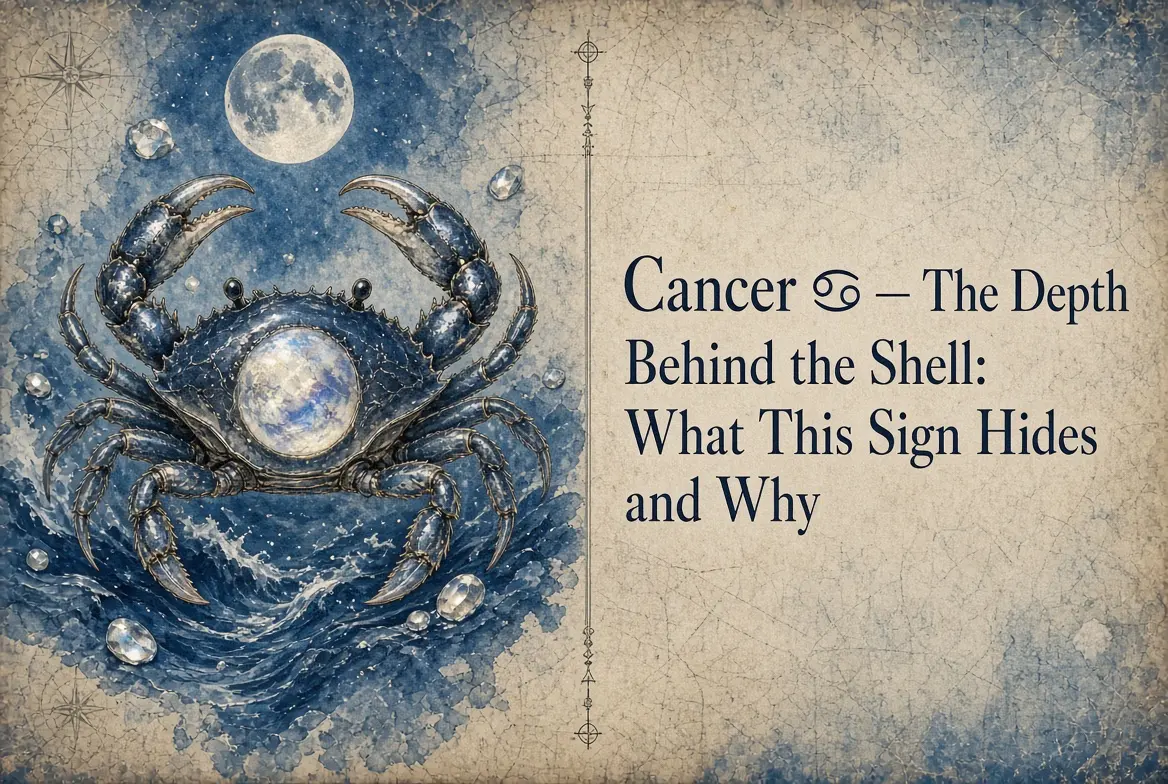
The crab has a hard exterior and a soft interior. This is not accident in the symbolism — it is exact. Cancer’s exterior, when they are protecting themselves, can be genuinely difficult to penetrate. Cool, withdrawn, self-sufficient to a degree that looks like they don’t need anyone. This is the shell.
What most people get wrong about the shell: they think it is the real Cancer. They meet the shell, they experience the withdrawal or the moodiness or the self-sufficiency, and they conclude that this is who Cancer is. It isn’t. The shell is a response. What produced the shell is what matters.
Most Cancer shells were built in response to something specific. An early experience of having their emotions dismissed, mocked, or treated as inconvenient. A loss that arrived before they had the capacity to process it. A relationship where being open cost them something significant. The shell went up not because Cancer decided to be guarded but because they learned, from direct experience, that being unguarded had a price.
The softness inside is not hypothetical. Every person who has ever been fully trusted by a Cancer will tell you the same thing: they had no idea it was in there. The warmth, the care, the loyalty that has no conditions, the way Cancer holds the specific details of your life as if those details are important — none of this is visible from the outside. It is only available after the shell.
Getting past a Cancer’s shell is not an achievement you unlock by being persistent enough. It is something they choose to allow when they have accumulated enough evidence that you will not use the access against them. That evidence takes time. There are no shortcuts.
The Sensitivity They Got Told Was a Problem
Cancer is sensitive. This is accurate and it is not an insult, though it gets used as one.
What sensitive actually means in practice: Cancer picks up on things. The shift in someone’s tone before the words change. The tension in a room before anyone acknowledges it. The thing someone didn’t say. The way a silence feels different from how it usually feels. This is not imagination. It is a specific kind of perceptual accuracy that most people do not have and most social environments do not accommodate.
The problem is not the sensitivity. The problem is that the sensitivity has no standard social script. You cannot walk into a room and say ‘I notice the energy has shifted and I need to understand why before I can be present here.’ So Cancer holds what they notice and tries to function alongside it, which produces the moodiness that other people observe without understanding its source.
Most of what gets called Cancer moodiness is Cancer processing information that no one else in the room has consciously registered. They are not in a different emotional state for no reason. The reason just isn’t visible to anyone who isn’t reading the room at the same resolution Cancer is.
Being told you are too sensitive by someone with less sensitivity than you is like being told you see too much color by someone who is partially colorblind. The problem is not the perception. The problem is the mismatch between what you notice and what the people around you can follow.
How Cancer Loves
Cancer’s love language is not the five love languages framework, though they use all five. Cancer’s love is in the specific memory. The way they remember that you mentioned, once, that you hate cilantro. That your mother’s birthday is the 14th and you always feel complicated on that day. That the meeting on Thursday makes you anxious and you will need to decompress afterward.
Cancer stores this information not as a database but as care. Remembering the details of your life is how they love you. Showing up with exactly what you need before you have named what you need is how they love you. Making the space feel different — warmer, safer, more like home — is how they love you.
This love is quiet and consistent and it is very easy to take for granted, which is one of the specific griefs of being Cancer. The care they extend does not announce itself. It arrives in the form of things being handled, things being remembered, things being made easier without anyone being thanked for making them easier. If you have a Cancer in your life and you look back at the texture of your daily experience with them, you will probably find that a large amount of your comfort has been quietly produced by them.
Cancer loves through what they remember and what they do about it. By the time you realize how completely you have been taken care of, they have been doing it for months.
The vulnerability in this is significant. Cancer gives this way because it is natural to them, but it is not symmetric. They tend to be more attentive to other people’s needs than to their own, and they tend to wait to be noticed rather than asking to be seen. A Cancer who has been giving for a long time without anyone noticing is not fine. They are running a deficit that has been accumulating quietly, and the withdrawal that follows — the pulled-back shell — is often the first visible evidence of it.
The Fear Underneath
The fear that runs underneath most Cancer behavior is abandonment. Not in every Cancer and not in every moment, but as a structural feature of the sign: the thing they are most designed to protect against is losing the people they love.
This fear is not irrational. Cancer’s relationship with home — with the specific people and places that constitute safety — is stronger than most signs. What feels optional to an Aquarius or a Sagittarius feels essential to Cancer. The loss of home, in any of its forms, is not something Cancer bounces back from easily.
The shell, the sensitivity, the moodiness, the caretaking — most of it can be traced back to this root. The shell protects them from letting in people who will leave. The sensitivity lets them read the warning signs of departure before they arrive. The caretaking makes them indispensable. The moodiness is often the leak — the feeling of impending loss seeping through before there is anything to name.
Cancer does not fear loss in the abstract. They fear the specific loss of the specific people and places that make the world feel inhabitable. When those are secure, Cancer is one of the most grounded and generous signs there is. When they are uncertain, the shell goes all the way up.
The evolved Cancer — and I want to be specific about what evolution looks like here — is not one who has stopped fearing loss. It is one who has developed enough trust in their own ability to survive it. The shell does not disappear. It becomes a choice rather than a reflex. The opening happens not because the fear is gone but because the person has become large enough to hold the fear and open anyway.
What Cancer Actually Needs
Consistency. Not grand gestures — consistency. The same warmth on a Tuesday afternoon that was present on Saturday night. The follow-through on small things. The pattern of showing up that Cancer’s nervous system can eventually recognize as safe.
Cancer does not trust words the way some signs do. They trust behavior over time. Tell a Cancer you love them and they will feel it briefly. Show them, through repeated behavior, that you are not leaving — and something in them will begin to relax in a way that words cannot produce.
They also need to be allowed to feel what they feel without having to defend the feeling. This sounds simple and it is almost never done correctly. Not ‘I hear you but’ — just ‘I hear you.’ Not ‘you shouldn’t feel that way’ — just the acknowledgment that the feeling is real and present and does not require explanation or justification.
Cancer does not need you to fix how they feel. They need you to stay in the room while they feel it. The staying is the whole thing. Most people do not understand how rare that is for them.
They need someone who notices the caretaking and says so. Not in a formal way — just the occasional acknowledgment that Cancer has been handling things quietly and that it has been seen. This costs almost nothing to give and it means more than most people realize.
And they need, eventually, to learn that their needs are not an imposition. This is the work that takes the longest and requires the most from the people around them. Cancer has usually learned, somewhere early, that needing things makes them a burden. Unlearning that requires a specific kind of consistent evidence: someone who welcomes the need rather than tolerating it.
The Depth Behind the Shell
Here is what is actually in there, behind the guardedness and the moodiness and the sensitivity that everyone talks about.
A person who will remember the details of your life years after you have forgotten telling them. Who will show up at the specific moment — not the convenient one, the right one. Who will hold your history with a care that most people reserve for their own. Who loves in a way that is not contingent on you being at your best.
The shell is real. Getting through it is slow. There are no shortcuts and persistence alone is not enough — it is the right kind of consistent presence over time that opens it, and nothing else.
But what is on the other side of it is one of the more remarkable things available in a human relationship. Cancer at full trust is not the moody, withdrawn person the shell suggests. It is someone who has made you into part of what they protect. And Cancer protects what it loves with everything it has.
The people who earn a Cancer’s full trust tend to understand, afterward, that they were loved more completely than they realized at the time. The care was always there. It just arrived in a language it took them a while to learn to read.
If you are a Cancer reading this: the shell kept you safe when safe was what you needed. It does not have to be permanent. The right people will wait for it. And the ones who won’t were never going to understand what was inside it anyway.
SHARE THIS if you are a Cancer who has been called too sensitive 🌊💙
— GinaStars.com