GinaStars.com
Moon water is one of those practices that sounds elaborate until you realize it is just water left outside overnight. That simplicity is the point. The ritual is not in the complexity — it is in the intention and the timing.
The concept is old. Water has been used in ritual across nearly every culture that has a recorded history — as a purifier, a conductor of energy, a medium between the physical and whatever exists alongside it. The specific practice of charging water under moonlight appears in folk traditions across Europe, Asia, and indigenous American practices, each with different explanations for why it works but converging on the same basic method.
What follows is how to do it correctly, what each moon phase produces, and how to actually use what you make rather than letting it sit in a jar on your windowsill for three weeks.
Moon water is not complicated. It is water with intention and timing. Most people who try it and feel nothing skipped one of those two things.
What Moon Water Actually Is
Water left under the light of the moon overnight, with clear intention about what you want it to carry. That is it. No specific container required, no particular brand of water, no elaborate setup.
The mechanism, depending on your framework: water is one of the most receptive substances on earth. It is used in homeopathy, in ritual cleansing across religions, in healing practices that predate recorded history, specifically because of this quality. Whether you understand the receptivity as molecular (water’s hydrogen bonds create a structure that responds to electromagnetic frequencies, and moonlight is electromagnetic radiation) or as energetic (the moon governs the tides, which are water, and also governs the body, which is 60% water), the underlying logic is the same. Water responds to what it is exposed to.
The intention you set before placing the water matters because it directs what the water is absorbing. Intention in this context is not wishful thinking — it is focus. You are telling the water what to hold. This is why two jars left under the same moon by different people with different intentions produce water that feels different to them. The moon is the same. The direction of the charge is different.
The moon charges the water. The intention tells the water what to do with that charge. Both are necessary. Water left outside with no awareness produces moon water the way a phone left on vibrate produces a call — technically possible but missing the point.
What You Need — and What You Don’t
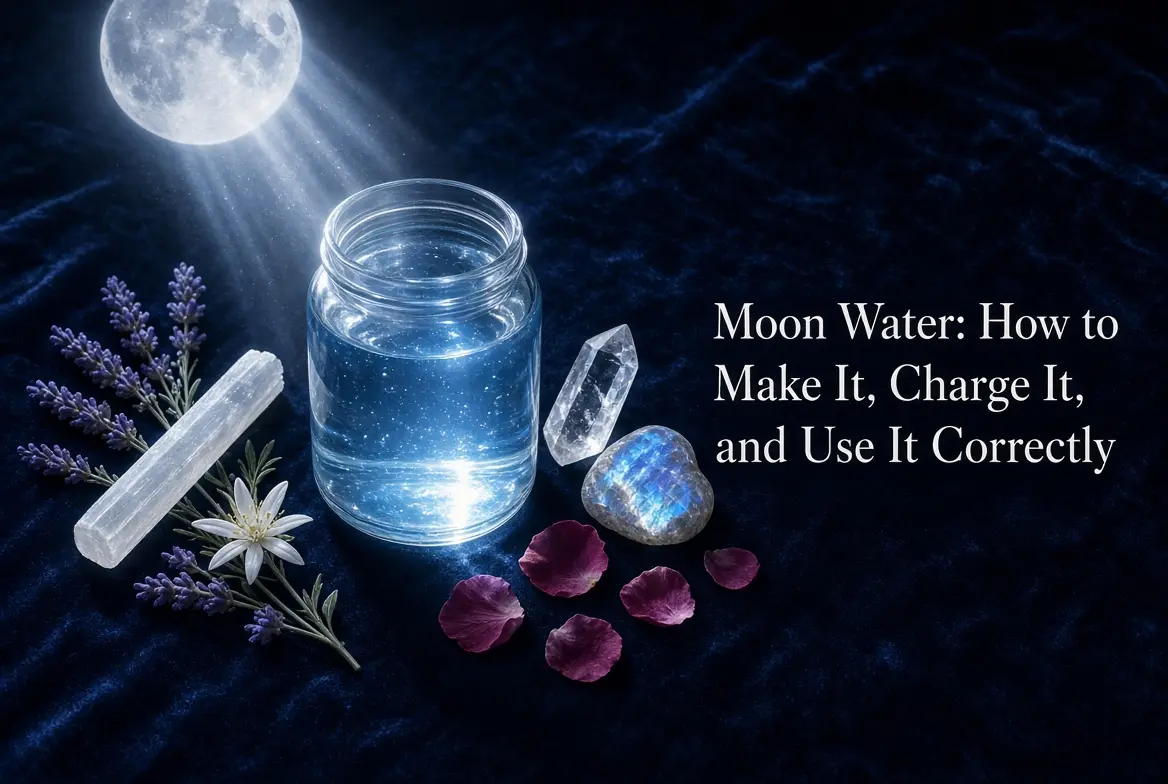
What you need: a glass container, water, and access to moonlight. That is the full list.
Glass is the standard recommendation because it is inert — it does not leach anything into the water and it does not interfere with what you are trying to charge. Plastic works in a functional sense but is porous and degrades over time in ways that glass does not. Mason jars are fine. A crystal glass is fine. A old pasta sauce jar with the label peeled off is also fine.
The water: filtered is cleaner, tap works, rain water is traditional in many practices and considered more energetically receptive because it has already been in the sky. Spring water is the other traditional choice. I use filtered tap because that is what I have and I have not noticed a meaningful difference in the result.
What you do not need: specific crystals placed around or in the water (though you can add them if you want to layer the intention), a particular phase of the moon (though phase matters significantly for what you use it for — more on this below), or any ritual paraphernalia beyond the jar and the water.
What ruins moon water: forgetting it outside when it rains and the jar fills up, using a container that has soap residue, leaving it in direct artificial light rather than natural moonlight, and — the most common mistake — making it during a storm when the moon is not visible. The moon does not need to be directly above you. It does not need to be cloudless. But some visibility helps.
The Method
Set your intention before you fill the jar. Not after. Sit for a moment with what you want this water to carry — not a shopping list, one clear thing. Release. Clarity. Healing a specific wound. Energy for a specific project. Love, if you want, but love for what and in what direction.
Fill the jar. Hold it in both hands for a moment and let the intention move from you into the water. Some people speak it aloud. Some people write it on a piece of paper and place it under the jar. Some people simply think it clearly. The method is less important than the clarity.
Place the jar where moonlight can reach it — a windowsill works, outside is better. If you are placing it inside, the window does not need to be open. Glass filters some wavelengths of moonlight but enough gets through.
Leave it overnight. Take it in before the sun rises if you want to preserve the moon charge specifically — sunlight adds its own energy and will change the quality of what you made. If you forget and it sits in morning sun for an hour, you now have water charged by both moon and sun, which some practitioners use intentionally. It is not ruined. It is different.
Cover the jar if you are leaving it outside, or strain it if any debris has gotten in. Then use it within a few days to a week if it is meant to be ingested. Moon water kept for longer than a week can grow bacteria, particularly if it has been opened or if any organic material was added.
The most important part of the method is the intention before you begin, not the ritual around it. Everything else is container.
How Moon Phase Changes What You Make
This is where most guides on moon water skip the most useful information.
Full moon water is the one most people know. The moon at maximum illumination produces water that carries release energy — it is good for letting go of what you have been holding, for emotional processing, for cleansing. This is the water you use in rituals designed to close something, clear something, or end something with intention rather than just letting it drift.
New moon water is less commonly made but arguably more useful for specific purposes. The moon at new phase — invisible, the sky dark — produces water that carries beginning energy. Plant seeds with it. Start practices with it. Set new intentions into it. New moon water is for openings, not closings.
Waxing moon water — made during the two weeks between new and full when the moon is growing — carries growth energy. Use it when you want to build something, increase something, or move toward something. Good for abundance work, creative projects, anything you want more of.
Waning moon water — made during the two weeks between full and new when the moon is shrinking — carries release energy similar to the full moon but subtler. It is the slow release rather than the sharp one. Good for habits you are trying to dissolve gradually rather than dramatically.
Full moon water and new moon water are not interchangeable. Using full moon water to start something is like planting seeds in autumn — you can do it, but you are working against the cycle rather than with it.
How to Actually Use It
This is where most people’s moon water practice stalls. They make it, they put it in a jar, and it sits on the windowsill until they tip it down the drain a month later because they forgot what it was for.
Drink it. This is the most direct method and the one most people overthink. Add it to your morning water, your tea, your coffee if you drink it black. The intention is in the water. Drinking it brings it into the body. This is particularly useful for water made with intentions around healing, clarity, or emotional processing.
Use it in your bath. Add the entire jar or a portion of it to bath water along with whatever else you use — salts, oils, botanicals. The bath becomes a vessel for the intention. For full moon water, this is a release bath. For new moon water, an intention-setting bath.
Water your plants with it. Plants respond to the energetic quality of water in ways that are observable even without a metaphysical framework — plants watered with intention consistently do better than those watered mechanically, a finding that appears in several small horticultural studies even if the explanation varies. Use waxing moon water for growth, waning for pruning energy.
Anoint crystals or sacred objects. A few drops on a crystal you use regularly cleanses it without the salt that damages some stones. New moon water for setting new intentions into a crystal, full moon for clearing old ones.
Use it in cleaning. Add it to the water you mop with if you are doing an energetic clear of a space. Wipe down doorframes. Wash windows with it. Full moon water in cleaning carries the specific energy of clearing out what does not belong.
Spray it. Put it in a small spray bottle. Use it around a room, around yourself, around your workspace. This is the fastest application and the one I recommend for people who are new to the practice and not yet sure they want to commit to the full bath or the daily drinking.
The Questions People Actually Have
Can you make moon water during an eclipse? Technically yes. In practice, most astrologers recommend against it — eclipse energy is unpredictable and the water made during one tends to carry that quality. It is not dangerous. It is also not what most people are looking for from a moon water practice.
Does it matter if it is cloudy? No. The moon’s influence on the tides does not require clear skies, and neither does its influence on water you are leaving out. The light is less visible but the energy is present. That said, a clear night under a visible full moon produces something that feels different from a cloudy one, and I think the visibility matters for setting intention — it is harder to connect to something you cannot see.
How long does it keep? Shelf life depends on the water and the storage. Sealed, in a dark cool location, a week to ten days for drinking. Several weeks for topical use or cleaning. If you add anything organic — a flower, a crystal that may have residue — check it before using it. Trust your nose. If it smells off, it is off.
Do you have to do it every month? No. Make it when you need it. The practice is not about accumulating moon water — it is about using it intentionally when the timing and the need align.
Moon water works best when it is made for a specific purpose and used within a reasonable time. A jar made with clear intention and used within the week does more than a collection of jars with vague energy sitting on a shelf for months.
A Word on What This Actually Is
Moon water is a practice. Not a treatment, not a supplement, not a medical intervention. I want to be clear about this because the internet has a tendency to blur these lines in wellness content, and blurring them does a disservice to both the practice and the people using it.
What it is: a way of working with intention and natural timing to create something that carries a specific energetic direction. Whether you understand that as the structured memory of water, as the alignment of human attention with planetary cycles, or as placebo with ritual reinforcement — all of those explanations produce the same outcome if the practice is done with genuine focus.
What it is not: a cure, a replacement for anything medical, or something that requires a particular belief system to work. The people who get the most from moon water are usually the people who approach it as a practice of intentional attention — a way of doing something with purpose rather than drifting through days on autopilot. That benefit is real regardless of your framework for explaining it.
Make it under the next full moon. Set one clear intention. Use it within a week. Notice whether anything shifted.
That is the whole practice. The rest is elaboration.
SHARE THIS with someone who needs to start their moon practice 🌕💧
— GinaStars.com