GinaStars.com
Something has shifted. You cannot fully name it. You are not depressed — it is not quite that. You are not sick. But you are different from the person you were a year ago in ways that feel larger than the usual kind of changing, and the people around you have not changed with you, and some part of you wonders whether you are losing your mind.
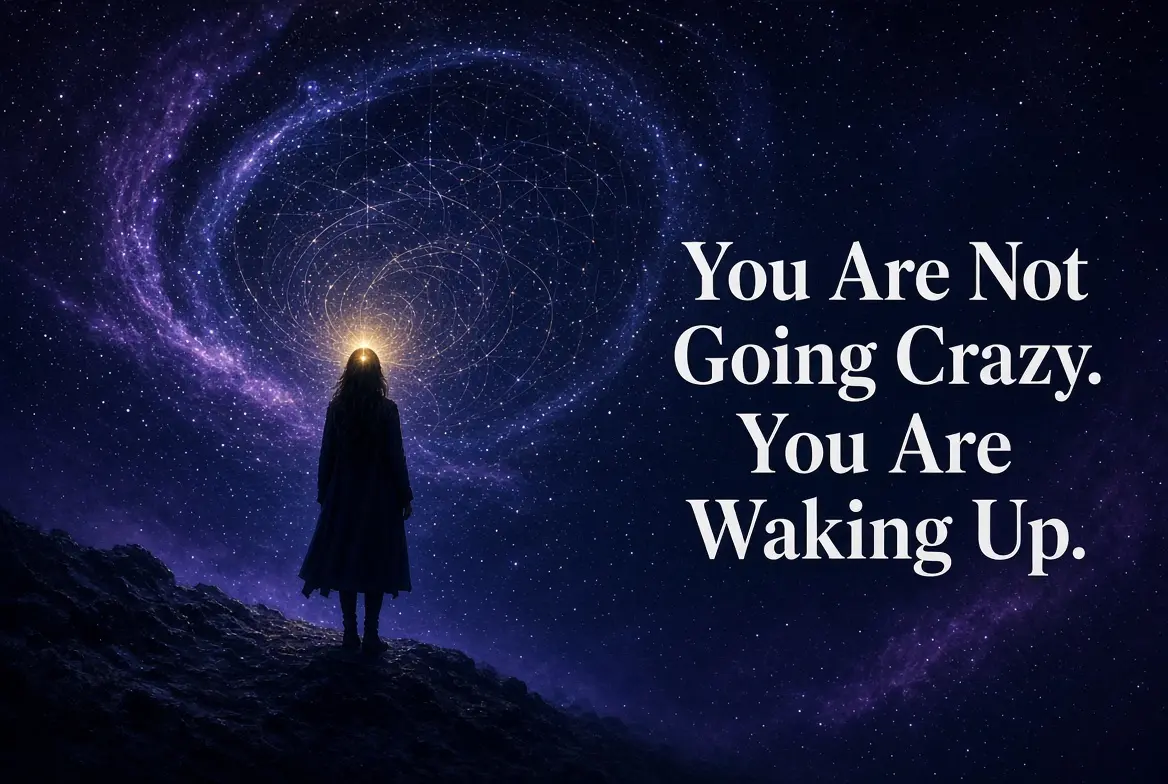
You are not.
What you are describing has a name. Spiritual awakening is the most common one, though the phrase has been diluted by overuse into something that sounds more decorative than it is. In practice it is not decorative at all. It is the experience of your consciousness reorganizing itself around a different understanding of reality — and that process is, almost without exception, disorienting before it is anything else.
Here are 11 signs that what you are going through is not a breakdown. It is a waking up.
The early stages of awakening feel almost identical to falling apart. The difference is direction. Falling apart goes down. Waking up goes through.
1. You feel restless without knowing why
Not anxious in the clinical sense — though sometimes that too. More like a persistent low-level friction with your own life. Things that used to feel satisfying no longer do. The job, the social routine, the way you spent your Sundays — none of it is necessarily bad, but it fits differently than it did. Like wearing a coat that was the right size last winter and is now somehow too small even though you haven’t visibly changed.
This restlessness is the first signal. The self that is waking up is larger than the life that was built for the self that was asleep. The coat doesn’t fit because you don’t fit the old version anymore. That is not a problem. It is information.
2. You can’t watch the news or scroll social media the way you used to
Specific, physical discomfort. Not just disagreement with the content — a somatic response. The anxiety, the cruelty, the performative outrage, the low-frequency noise of it — it hits differently now. Where you used to scroll through it and feel vaguely bad, now you feel it immediately and have to stop.
This is not sensitivity becoming pathological. It is sensitivity becoming accurate. You are picking up on the actual frequency of the content rather than the filtered, comfortable version your previous attention level was processing. The discomfort is real information about what you are absorbing. Most people who report this during awakening eventually reduce their consumption significantly — not out of avoidance, but because the cost of not doing so becomes too high.
3. Your relationship with time feels different
Days feel simultaneously very long and very short. A week passes in what feels like two days and then a single afternoon stretches into something enormous. You lose track of months. You wake up and cannot immediately place what year it is in terms of how your life feels.
This is a well-documented feature of consciousness shifts. The ordinary experience of time as a consistent linear medium depends on the self remaining stable as a reference point. When the self is reorganizing, the reference point moves, and time behaves differently relative to it. Disorienting, yes. A sign of psychosis, no.
4. You are suddenly drawn to things you never cared about before
Astrology. Numbers on clocks. Crystals. Meditation. Books about consciousness that you would have rolled your eyes at two years ago. Philosophy you cannot entirely understand but feel pulled toward anyway. Synchronicities that you notice and cannot quite dismiss.
The content of the draw varies person to person — some people go toward Eastern philosophy, some toward indigenous wisdom traditions, some toward quantum physics. The direction is different. The pull is the same. Something in you is looking for a framework large enough to hold what you are starting to experience. The things you were given before — the familiar cultural, religious, or secular frameworks — are not quite fitting anymore.
5. Old relationships feel strained without anything obviously happening
No fight. No betrayal. Just a growing sense that certain people in your life are speaking a language you used to speak fluently and now have to translate. The conversations that used to feel natural feel shallow. The things they care most about feel distant from where you actually are. And you feel guilty about this because they haven’t done anything wrong.
This is one of the hardest parts. The people around you did not change. You did. And the gap that creates — watching people you genuinely love through glass you cannot explain — is a specific loneliness that the standard vocabulary doesn’t quite cover.
The loneliness of awakening is not the loneliness of being unloved. It is the loneliness of being in a different place than the people you love, and not being able to explain how you got there.
6. You are sleeping differently
Either too much or too little. Waking at the same time every night — 3am is the most commonly reported, and there is a reason for this that multiple traditions have noted independently: the hour between 3 and 4am is when the body’s cortisol levels are at their lowest and the veil between conscious and unconscious processing is thinnest. Dreams are more vivid. Some are clearly meaningful in ways you cannot dismiss even if you cannot fully interpret them.
The sleep disruption during awakening is real and it is also temporary. The system is processing more than usual. It needs more time in the states where deep processing happens — which is why sleep becomes strange rather than simply absent.
7. You cry more easily, and not always at things that are sad
Music that hits a certain frequency. A stranger’s kindness. A sunset that for no particular reason produces tears before you have even registered an emotion. Something that should be mildly touching producing a response that is completely out of proportion to the stimulus.
The threshold has lowered. The membrane between felt experience and expressed emotion is thinner. This is the nervous system responding to more input than it previously registered — not a sign of instability, but of increased sensitivity. The membrane thins during awakening because a thinner membrane is required for what comes next.
8. You have started noticing things that feel too specific to be coincidence
Angel numbers. Songs that play at the exact moment you were thinking of something they describe. Conversations with strangers that address exactly what you have been privately working through. Books falling open to pages that answer questions you hadn’t asked aloud. The sense that the world is communicating with you rather than simply happening around you.
I’m not going to tell you what these are or aren’t. What I will say is that the people who dismiss them entirely and the people who over-interpret them tend to miss the same thing: the synchronicities are most useful as confirmation that you are paying attention in a new way. What you notice changes when you change. The world has always been this specific. You are just reading it differently now.
9. Your body is doing things it didn’t used to do
Tingling, usually in the hands or the top of the head. Warmth that moves through the chest. Pressure between the eyebrows — the third eye location — that is not a headache but is also not nothing. Ringing in the ears that comes and goes. A buzzing or vibrating sensation that is not pain and has no physical cause your doctor can identify.
These are the experiences that most often send people to Google at 2am searching for either a medical explanation or a spiritual one. The medical explanation comes back with nothing. The spiritual explanation uses language that feels either too religious or too new-age to quite fit. What is actually happening, as best as anyone can describe it: the nervous system is adapting to a different relationship with the body’s own energy. It produces physical sensation. The sensation is real.
10. You have lost interest in performing
Not performing in the theatrical sense. The daily performance — the version of yourself you assembled for work, for family, for the particular social context that required a particular face. That performance used to feel relatively effortless. Now it feels like work. Now there are moments when you catch yourself doing it and feel something close to alienated from the person doing it.
The self that is waking up is less willing to pretend than the self that was asleep. This creates friction in environments that required the pretending — which is most of the environments most people inhabit most of the time. The friction is not comfortable. It is also not wrong. The performance was always a performance. The discomfort is the gap between the performance and the thing underneath it becoming impossible to ignore.
The performance doesn’t stop because you decide to stop performing. It stops because the self doing it starts noticing the gap between what is being performed and what is actually true — and the gap becomes uncomfortable enough that the performance starts to cost more than it’s worth.
11. You feel like you are between things
Not lost exactly. Between. The old version of your life has clearly run its course — that much is visible. The new version has not yet shown itself in any form you can describe. You are in a kind of liminal space with no clear map and no obvious next move, and the discomfort of that in-between state is substantial.
This is the most specific sign of awakening, because it is the one that is most uniquely characteristic of the process. Depression tends to remove the future. Anxiety tends to fill it with catastrophe. The awakening in-between state is different: the future is present, it is just not visible yet. Something is ending and something is beginning and you are standing in the gap between them without knowing what is on the other side.
That gap is not nothing. In most traditions that describe awakening, the liminal space is where the actual transformation happens. The old structure has to be genuinely gone before the new one can form. You are not in the gap because you have failed to reach the other side. You are in the gap because this is where the work of transformation lives.
What This Is Not
It is not a breakdown, though it can look like one from the outside and feel like one from the inside. A breakdown goes down. This goes through.
It is not something that requires fixing in the clinical sense — though if the anxiety or depression symptoms are significant, support is worth seeking and there is no contradiction between spiritual awakening and mental health care. They are not competing explanations.
It is not something you chose, necessarily. Most people who describe awakening describe it as something that happened to them rather than something they decided. A loss, an illness, a period of sustained inauthenticity, a single moment of clarity — something cracked the surface of the ordinary version of reality and what was underneath started coming through.
What To Do With It
Rest more than feels justified. The system is working harder than it appears to be.
Find people who are in or have been through a similar process. The loneliness of awakening is real but it is also partly a function of not knowing where the other people are. They exist. Finding even one person who speaks the language of what you are going through changes the quality of the experience significantly.
Do not rush the in-between. The urgency to resolve the liminal space — to get to the other side, to know what comes next — is understandable and also counterproductive. The gap works on its own timeline. Your job is to stay honest while you’re in it.
Write things down. Not because journaling is a spiritual obligation, but because the experiences of awakening are strange and specific and tend to become clearer when you try to put them into words. The act of description is itself a form of processing.
You are not going crazy. You are becoming someone your previous life was not quite built for. That is uncomfortable. It is also, once you are through it, the thing most people describe as the beginning of actually being alive.
You found this for a reason. You are not the only one in it.
SHARE THIS if you have been feeling like a completely different person lately 🙏✨
— GinaStars.com