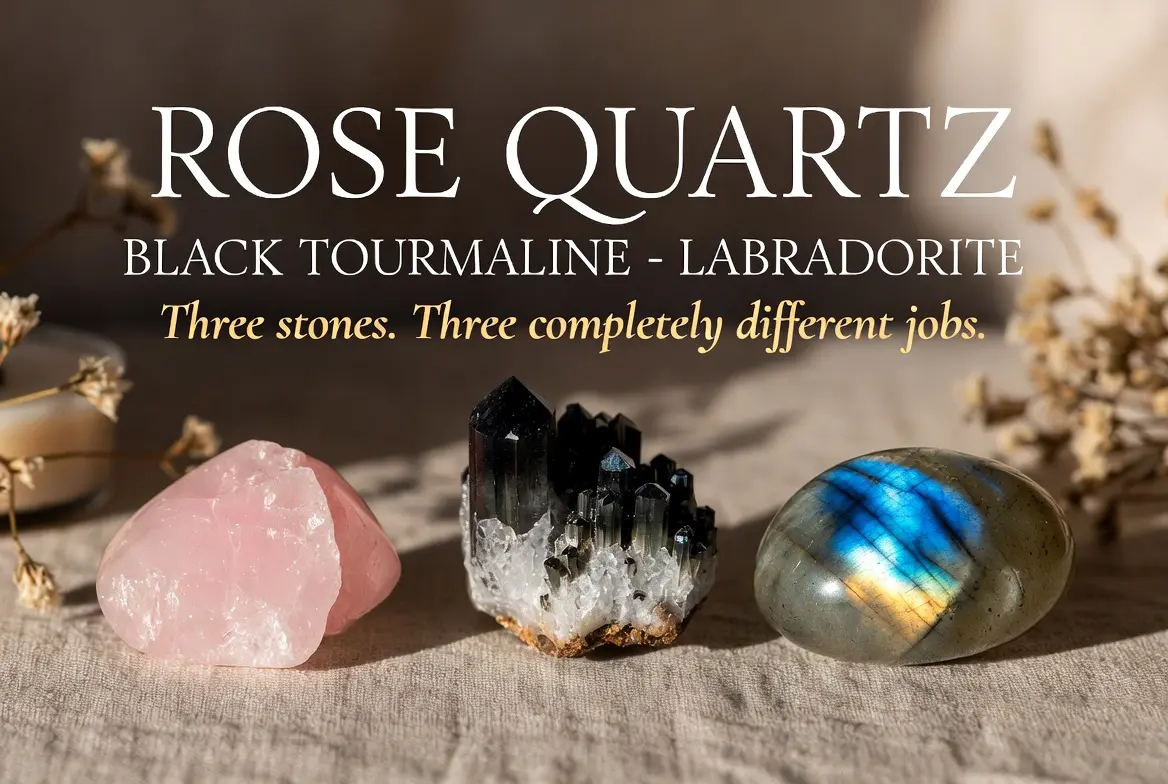
Rose quartz, black tourmaline, and labradorite get lumped together as a starter kit. They actually do nothing alike.
By Gina, GinaStars
These three show up in almost every beginner crystal kit you can buy, which is a little funny, because they’re not actually a matched set. Pink, black, and grey. Love, safety, and clarity. If you only own three stones, these three cover more emotional ground than almost any other combination, but for completely different reasons.
I want to walk through what each one actually does, because the popular version of each story leaves out the most useful part.
Rose quartz isn’t really about finding love
Ask anyone what rose quartz is for and you’ll get the same one word answer every time. Love. That’s not wrong exactly, it’s just incomplete.
Rose quartz gets its pink colour from trace titanium or manganese, and the love reputation goes back to ancient Egypt and Rome, where it shows up in beauty rituals and gets tied to Aphrodite and Venus. Real history. Just not the most useful lens for what most people actually need from it.
What it’s genuinely good for is softening the exact moment your internal voice turns cruel. You mess something up and the voice in your head says something you’d never say to a friend. That’s the moment to hold it, not during some abstract self love meditation. The few seconds of pause it gives you is often enough to change the tone of whatever thought comes next.
It’s also quietly one of the better grief stones, and almost nobody talks about that side of it. Loss tends to harden you, close something off as a defence. Rose quartz supports staying soft instead of calcifying around the pain. Not skipping the grief. Just not letting it turn permanent.
It won’t make someone fall in love with you. What it changes is how you talk to yourself, which, fair enough, eventually changes who you’re willing to let love you back.
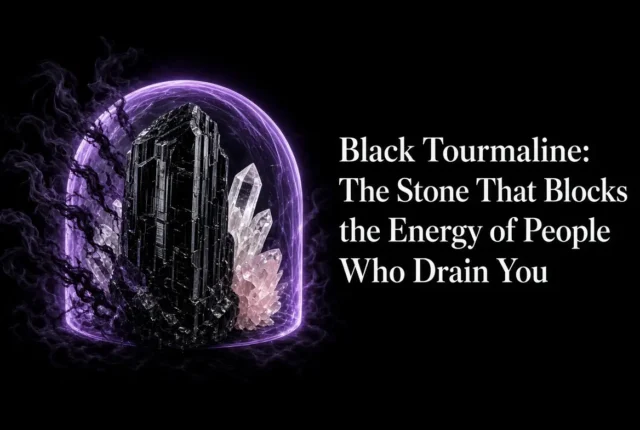
Black tourmaline is the one nobody buys for fun
This stone has zero glamour. Mostly black, sometimes rough, shaped like a stubby little tower. Put it next to amethyst on a shelf and your eye slides right past it.
And it’s one of the best selling crystals in the world, because nobody buys it for how it looks. They buy it mid breakup, mid burnout, mid something. Also called schorl, it’s genuinely strange physically, it’s pyroelectric and piezoelectric, meaning it builds an electrical charge under heat or pressure. That’s documented mineralogy, not folklore, and it’s part of why centuries of energy related meaning ended up attached to it.
People describe it as grounding and protective, and those are two different jobs. Grounding is feeling anchored in your body instead of spinning through anxious thoughts. Protective is a felt boundary between you and whatever’s draining you, a person, a room, the news.
I want to be direct about where this stone stops being useful. If you’re in an actually unsafe situation, an abusive relationship, a job wrecking your health, a rock will not fix that. Feeling unsafe is information, and the right move is acting on the source, not just regulating your nervous system to keep tolerating something you shouldn’t.
Where it earns its reputation is the much more common case. You’re safe now, but your body hasn’t caught up. Holding something solid and heavy enough to register in your hand is a basic grounding technique therapists already use, crystal beliefs aside. This stone just gives that technique a little more weight, literally and otherwise.
Labradorite shows you what you weren’t looking at
This one looks like a plain grey rock until you tilt it, and then it flashes blue and gold like something switched on inside. It’s a feldspar mineral named after the Labrador Peninsula in Canada, and the flash effect has its own name, labradorescence, caused by thin internal layers bending light depending on the angle.
That’s just optics. But the metaphor it hands you is one of the best in the whole crystal world. What looks unremarkable from one angle is hiding something completely different from another, and you only see it if you’re willing to move.
People reach for it most during real transitions, not small tweaks, the actual messy middle of leaving one version of yourself and not yet landing in the next. You can’t see your own situation clearly from inside it. Wrong angle. A stone whose whole identity is about needing the right angle to reveal anything is a fairly good reminder that what you can’t see right now isn’t gone, it’s just not catching the light yet.
It’s also tied to intuition more than almost any other stone, and the mechanism is simpler than it sounds. Intuition is pattern recognition your brain finished before your conscious mind caught up. Sitting with the stone, watching for the flash, forces a small pause that gives that quiet processing room to actually surface.
Why these three actually work together
Rose quartz works on how you talk to yourself. Black tourmaline works on whether your body feels safe enough to function normally. Labradorite works on whether you’re seeing your situation from the right angle at all.
Put together, that’s a pretty complete kit for getting through something hard. Not because the stones are doing anything measurable, but because each one gives you a different, specific, physical thing to do at exactly the moment you need it. Hold the pink one when the voice turns cruel. Carry the black one when the room feels unsafe. Tilt the grey one when you suspect you’re not seeing the whole picture yet.
None of that is magic. It’s just having a plan for three very different bad moments, instead of one vague crystal sitting on a shelf doing nothing in particular.