Before the 1800s amethyst was worth as much as diamonds. Here is what we forgot about it.
By Gina — GinaStars
I have bought amethyst more times than I can count and given most of it away and then bought it again.
That probably tells you something. Amethyst is not the flashiest crystal in the collection. It does not do that cool color shift thing labradorite does or glow blue from the inside like moonstone. It is just purple. Sometimes really deep purple, sometimes so light it is almost pink, sometimes so dark it looks almost black depending on how the light hits it.
I usually put it on my desk. On my nightstand. In my bag when something stressful is happening. And it helps. I do not totally know how to explain that without sounding a little unhinged. I am not unhinged. I just think this stone gets talked about in a really boring and surface level way and it deserves better.
Every crystal article about amethyst says the same stuff. It is calming. It helps you sleep. It is good for intuition. Sure. All of that is real. But none of it explains why humans have been obsessed with this stone for over two thousand years across completely different cultures and time periods. So let me actually try to explain it.
What amethyst is made of
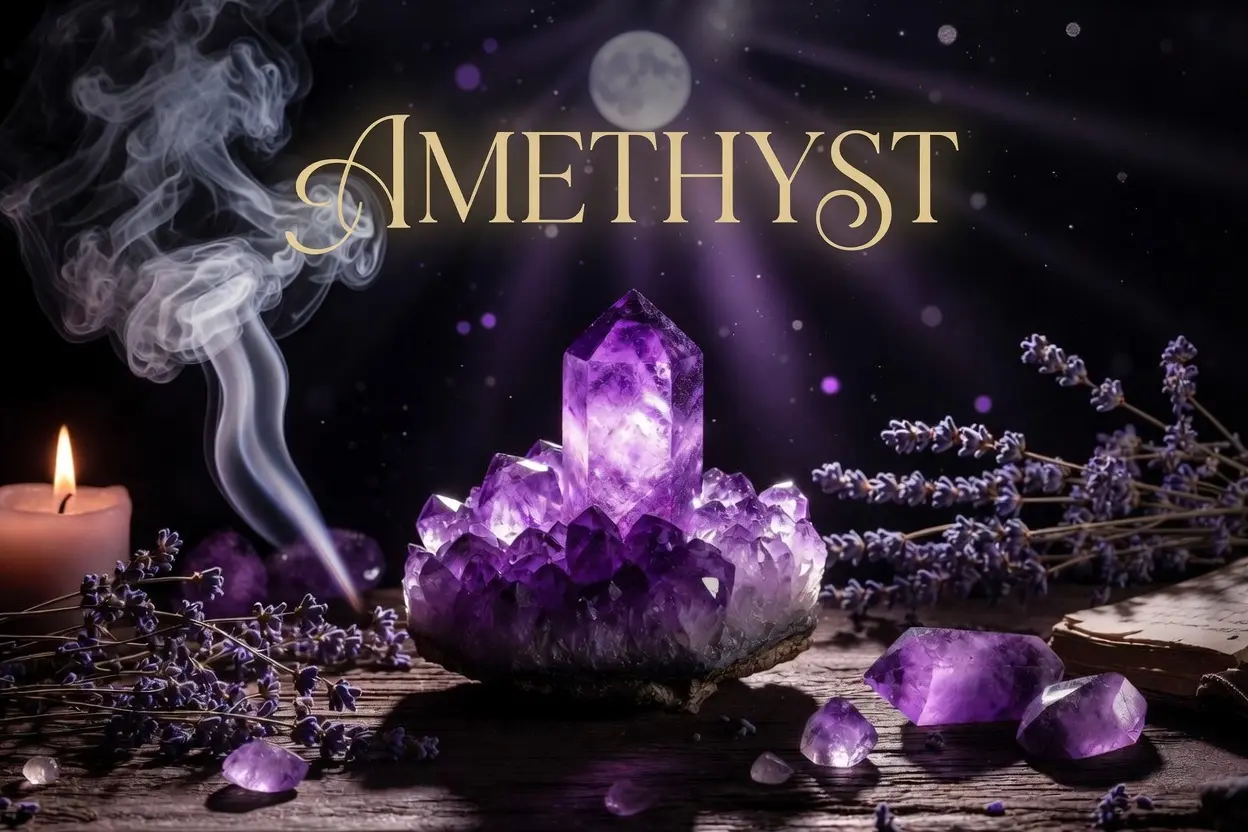
Amethyst is a type of quartz. The purple color comes from iron that got trapped inside the crystal while it was forming, plus natural radiation from the earth around it. More iron and more radiation equals darker purple. That is why you can find everything from the palest lilac to an almost black deep violet and they are all technically the same stone.
The name comes from an ancient Greek word — amethystos — which means not drunk. And the Greeks were being completely serious about that. They wore amethyst jewelry and drank out of cups carved from amethyst because they genuinely believed it would stop them from getting drunk. Some historians think this happened because wine poured into an amethyst cup looked like water when it was watered down. Whatever the reason, the connection between amethyst and having a clear head goes back a very long time.
The best quality amethyst comes from Brazil, Uruguay, Zambia and South Korea. Brazilian amethyst tends toward large formations with lighter purple. Uruguayan amethyst is darker and more intense. Zambian amethyst is often the finest in terms of color depth and clarity. If you find a deep rich purple with good transparency you are probably looking at something Zambian or Uruguayan.
Amethyst in the past was considered a precious stone for most of human history. Not semi-precious. Precious. It was in the same category as diamonds, rubies, sapphires and emeralds until the nineteenth century when large deposits were discovered in Brazil and the supply suddenly became enormous. Before that it was genuinely rare and genuinely expensive.
The ancient Egyptians used it in amulets and burial objects. It appears in the breastplate of the High Priest in the Hebrew Bible, one of twelve stones representing the twelve tribes of Israel.
Medieval European soldiers wore amethyst in battle believing it would keep them calm and clear headed. Catherine the Great of Russia was obsessed with it and commissioned enormous amounts of amethyst jewelry. The British Crown Jewels contain several significant amethysts.
I find this history useful not because it proves anything mystical but because it tells you something about the consistent human relationship with this stone across completely different cultures and time periods. People who had access to every gemstone available kept choosing amethyst for specific purposes. Not decoration. Purpose.
The clarity purpose is the thread that runs through all of it. The Greeks and their drinking cups. The medieval soldiers wanting clear heads in battle. The priests and their breastplates. Amethyst keeps showing up in contexts where someone needed to think clearly and act from a place of genuine knowing rather than clouded judgment.
What amethyst actually does
I want to be careful here because I think this is where crystal content usually loses me. The claims get big and vague and I end up feeling like I am being sold something. So here is what I can say honestly from years of working with this stone.
Amethyst is the stone I reach for when my mind is too loud. Not when I need answers. When I need the noise to come down enough that I can hear the thing I already know underneath it. There is a difference between thinking and ruminating and amethyst seems to interrupt the rumination without interrupting the actual thinking.
I cannot explain the mechanism. I just know that sitting quietly with a piece of amethyst for ten minutes tends to produce more clarity than forty minutes of anxious circling without it.
A friend of mine who is deeply skeptical of crystal work tried it during a period when she could not sleep because of work stress. She put an amethyst cluster on her bedside table mostly to humor me. She texted me two weeks later to say she was sleeping better and she was annoyed about it because she had wanted to be right that it would not work. She still has the cluster. She has since bought two more.
I am not claiming the stone did something to her brain chemistry. What I think happened is more interesting than that. The act of setting an intention, of placing something beside your bed and deciding it represents rest and calm, changes how you approach the night. The stone is the physical anchor for the intention. Whether there is anything more than that happening I genuinely do not know. But the intention anchored in something physical works better than the intention alone.
Amethyst and the third eye
Okay so if you have spent any time in the crystal world you have probably heard that amethyst is a third eye stone. And you have probably also nodded along without anyone actually explaining what that means in a way that makes sense in real life.
So here is my version of it.
The third eye is basically your internal knowing. Not your logical brain that makes lists and weighs pros and cons. The other thing. The part of you that walked into a room once and immediately felt something was off before you could identify what. The part that knew a relationship was over about six months before you were ready to admit it. The part that sometimes just knows and cannot explain how it knows.
Amethyst is connected to that. The crown chakra above it is about something even bigger — that feeling of being connected to something larger than your own immediate problems and opinions. The perspective that comes when you zoom out far enough.
I think about both of these things when I notice that amethyst keeps showing up in spiritual and ritual contexts across completely different cultures and time periods. Cultures that never spoke to each other. That had wildly different beliefs about almost everything. And they all kept reaching for the same purple stone in the same kinds of moments.
That is not nothing.
It is not that people universally agreed on a specific belief system. It is that they kept reaching for the same stone when they needed access to a kind of knowing that is harder to access in a noisy ordinary state. That kind of knowing is real. It is not supernatural. It is the thing that happens when you get quiet enough to hear the information your body and subconscious have already collected but your thinking mind has been too loud to register. Amethyst seems to help people get to that state faster. Again, I cannot tell you exactly why. I just know it does.
If you are drawn to amethyst during a period of confusion or decision making, I would take that seriously. Not as a sign that the stone will give you answers but as a sign that something in you is trying to get quiet enough to hear what it already knows.
How to actually use it
Here is what I do and what I have seen work for other people.
For sleep and mental quiet, keep a piece on your bedside table or under your pillow. The intention matters as much as the stone. When you place it, take a moment to actually decide what you want from it. Not vaguely. Specifically. I want to sleep without my brain running the same loop it ran yesterday. I want to wake up clearer than I went to bed. That specificity helps.
For meditation, hold a piece in your non-dominant hand. I use amethyst specifically when I am meditating about something I am confused about. Not to get an answer but to get quiet enough that an answer can surface on its own. Hold it loosely. Do not grip it. The looseness is the point.
For daily clarity, keep a small tumbled piece in your pocket or on your desk. I have one that lives on my desk and I pick it up and put it down probably twenty times a day without thinking about it. The tactile interruption of picking up a smooth stone tends to pull me out of whatever spiral I am in for just long enough to reset.
Cleanse it regularly. Amethyst does well with moonlight especially full moon charging. Leave it on a window overnight. Some people use running water, but check your specific stone first as some amethyst can fade with prolonged water exposure. Sunlight can also fade the colour over time so moonlight is the safest option.
The one thing I want to say
I have given away a lot of amethyst over the years. When a friend is going through something hard and I am trying to figure out what to do that is useful, amethyst is often the solution. Not because I think it will fix anything. Because giving someone a physical object that says I thought of you and I wanted you to have something to hold is different from just saying I am sorry you are going through this.
The stone becomes a container for that care. Something they can pick up when the hard thing feels particularly hard and remember that someone was thinking about them when they chose it.
That is not magic. That is just what physical objects do when they are given with intention. They carry the meaning forward through time in a way that words do not always manage.
Amethyst has been doing that for two thousand years across cultures that had nothing to do with each other. Carrying meaning. Holding intention. Helping people get quiet enough to think clearly.
I do not think that is a coincidence. I just think it is one of those things that is true whether or not we have a satisfying explanation for why.
— Gina
GinaStars.com