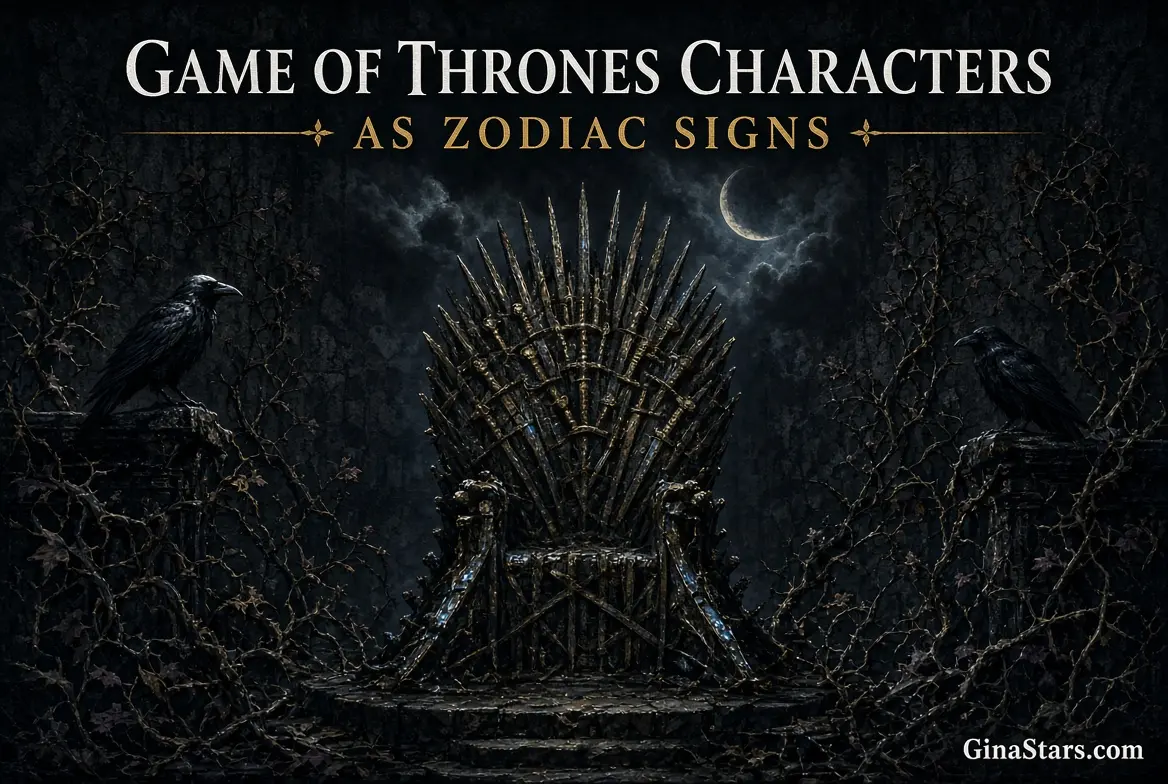
Westeros has twelve signs. Most of them end badly. Here’s why.
By Gina, GinaStars
Game of Thrones works as storytelling because the characters feel psychologically real in a way that most fantasy doesn’t achieve. Their choices make sense from the inside even when they’re disastrous from the outside. Their flaws are specific rather than generic. Their strengths and their undoing are often the same quality pointed in different directions.
That specificity is what makes the zodiac mapping so precise. These aren’t archetypes — they’re characters. And characters this well-constructed tend to embody their sign’s energy completely, shadow and all. Here’s where everyone lands.
Aries — Arya Stark
Arya is the clearest Aries in the entire series. She acts on instinct, she refuses to accept the role that’s been assigned to her, she pursues what she wants with a directness that has no patience for the political maneuvering happening around her, and she’s more effective than almost anyone in the series precisely because she doesn’t operate by the rules everyone else is bound by.
The Aries qualities in Arya are the ones that keep her alive when everyone else around her is being destroyed by playing the game properly. She doesn’t play the game. She ignores it and goes directly at what she’s decided to do. A man can give a girl a name. A girl has her own list. The list is Aries — specific, personal, maintained through years without losing momentum.
The Aries shadow in Arya is the cost of the single-mindedness. She becomes something in the pursuit that she has to consciously decide she doesn’t want to be completely. The scene where she chooses her name rather than becoming no one is the Aries choice: the self, preserved, over the completion of the mission. Most Aries would make that choice. The fact that it’s a real choice is the shadow.
If you’re the Arya of your group: you’re the one who actually does the thing while everyone else is strategizing about doing the thing. You’ve been underestimated. You’ve used that underestimation effectively. Your methods are not always orthodox. They work.
Taurus — Samwell Tarly
Sam is steady, loyal, underestimated, more capable than his presentation suggests, and operates through persistence and genuine care rather than through force or strategy. He’s not the exciting character. He’s the character who is still there at the end, who has been doing what needed to be done consistently while other people were having more dramatic arcs, and whose contribution turns out to have been essential.
The specific Taurus quality in Sam is the loyalty that doesn’t waver regardless of whether it’s reciprocated proportionally. His loyalty to Jon, to Gilly, to the Night’s Watch despite being terrible at the physical requirements of it, is not conditional on being treated well. Taurus shows up. Sam shows up. In a series where almost everyone abandons someone at some point, Sam’s consistency is the Taurus gift made narrative.
Sam also demonstrates the Taurus quality of genuine capability that exists underneath an unpromising exterior. He discovers the weakness of White Walkers. He performs medical procedures nobody else would attempt. He gets to the library and does the research that saves everything. None of this looks like heroism when it’s happening. All of it turns out to matter.
If you’re the Sam of your group: people have underestimated you for most of your life. You’ve been aware of it and have mostly not bothered to correct the impression because the work is the thing, not the recognition. You will outlast most of the people who dismissed you.
Gemini — Tyrion Lannister
Tyrion is the most purely Gemini character in the series and possibly one of the best Gemini characters in television. He’s the cleverest person in most rooms he enters, he processes the world through wit and language rather than through force or feeling, he adapts his presentation to whoever he’s dealing with with a fluidity that’s both a genuine gift and a survival mechanism, and he’s deeply aware of the gap between what he presents and what he actually experiences.
The Gemini quality in Tyrion that the show renders most clearly is the intelligence that can see everything clearly from the outside and still doesn’t protect him from the things that actually hurt him. He understands his family. He understands the game. He understands who everyone is and what they want and what the likely outcomes are. And he still loves Shae, still trusts Varys in the ways that matter, still makes the choices that wound him. The intelligence isn’t emotional insulation. It’s just intelligence.
Tyrion also demonstrates the Gemini dark side — the wit that becomes cruel when he’s been wounded enough, the verbal precision that can dismantle people as easily as it can charm them. The trial speech where he indicts the court is Gemini brilliance and Gemini fury simultaneously. The words are devastating and completely accurate and delivered with a control that’s actually barely holding.
If you’re the Tyrion of your group: you’re the funniest and the sharpest. You’ve used humor as armor for long enough that some people have no idea there’s anything underneath it. The people who know what’s actually there are the ones you’ve decided are worth being real with.
Cancer — Catelyn Stark
Catelyn is entirely organized around protecting her family. Every decision she makes, every alliance she pursues, every action she takes is in service of keeping her children alive and her house intact. The maternal ferocity is not performance — it’s the organizing principle of her entire existence. That’s Cancer.
The Cancer quality in Catelyn that the show uses most ruthlessly is the love that can’t be strategic enough. She releases Jaime Lannister in exchange for a promise to return her daughters, which is the Cancer choice: the concrete, present, emotional reality of a prisoner she can act on, over the larger strategic picture. She’s not wrong to love her daughters. The calculation is just incomplete in a way that Cancer’s calculations often are when the emotional stakes are immediate.
Catelyn also demonstrates the Cancer memory and the Cancer wound. She never forgives Jon for existing. Not because she’s cruel — because the reminder of Ned’s (apparent) infidelity is a wound that she has been carrying and cannot put down, and Jon’s presence reopens it every day. That inability to release the wound, even when the wound is causing collateral damage to someone who didn’t create it, is the Cancer shadow.
If you’re the Catelyn of your group: you would do anything for the people you love. You’ve done things that were not entirely strategically sound because the love was immediate and the strategy was abstract. You don’t entirely regret them. The people you love know you mean it.
Leo — Daenerys Targaryen
Daenerys begins the series as someone with no power and a complete conviction that she is destined for something significant. That conviction — held without evidence, sustained through years of genuine hardship and humiliation — is Leo. She believes in herself before there is any rational basis for believing in herself, and that belief eventually creates the evidence.
The Leo qualities in Daenerys are the ones that make her compelling for most of the series: the charisma, the genuine care for the people she sees as hers, the ability to inspire loyalty through the force of her vision, the capacity to be genuinely moved by the suffering of others and to act on that feeling. She frees slaves because she actually cannot tolerate slavery. That’s real.
The Leo shadow is the ending. The vision of herself as liberator becomes unable to accommodate the reality that not everyone wants what she’s offering. The love of the people, when it doesn’t arrive in the form she expected, tips into something else. The need to be seen as the hero becomes the need to be seen, period, and eventually becomes something that can’t distinguish between liberation and destruction. Leo’s shadow is the ego that can’t survive contradiction. Daenerys’s arc is that shadow at its most operatic.
If you’re the Daenerys of your group: you have genuine vision and genuine warmth and you believe in the thing you’re doing with your whole self. Watch the moment when the vision stops being about the people and starts being about the vision. That’s the Daenerys warning.
Virgo — Sansa Stark
Sansa begins the series as someone who believes in the stories — the proper stories, the right way things are supposed to go, the version of the world where knights are honorable and queens are powerful and everything follows the rules. And then the rules turn out to be a performance and underneath them is something much more brutal and she has to learn to navigate that brutal reality with absolutely no preparation.
What makes Sansa Virgo rather than just any character who learns from hardship is the specific mechanism of her growth. She watches. She attends to details. She learns the rules of the actual game by observing every player she comes into contact with, filing everything, and gradually constructing a more accurate picture of how power actually works. The intelligence isn’t performed — it’s accumulated, quietly, over years, in exactly the Virgo way.
The later Sansa — the one who outmaneuvers Littlefinger, who holds Winterfell together, who understands the political reality of the North better than Jon does — is the result of applying Virgo’s observational precision to a situation that required a different kind of understanding than she started with. She didn’t stop being detail-oriented. She changed what she was attending to.
If you’re the Sansa of your group: you’ve been underestimated and you’ve learned from that. You pay attention to things that other people dismiss as incidental. Your read on situations is usually more accurate than people expect from you, and you’ve learned to use the gap between their expectation and your actual understanding.
Libra — Jon Snow
Jon Snow is constitutionally incapable of choosing a side when both sides have people he cares about or principles he respects. The Night’s Watch and the wildlings. The North and the dragons. His family and his queen. His identity as a bastard and his identity as a Targaryen heir. Every significant choice in his arc involves holding two legitimate claims simultaneously and finding it nearly impossible to let either one go.
That’s Libra. The genuine understanding that both sides have a point. The inability to be strategic when the strategy requires treating one valid claim as if it doesn’t exist. The decision-making that is always slightly too slow because the decision requires acknowledging that something real is being lost no matter which way it goes.
Jon’s strength is also the Libra strength: he’s genuinely fair in a world that rewards the ruthless, genuinely concerned with what’s right in a world where right is usually the first casualty of ambition. His loyalty is real and it goes in multiple directions simultaneously, which makes it a genuine political liability and a genuine human gift.
The Libra shadow in Jon is the decisions he can’t make until circumstances make them for him. Killing Daenerys. Taking the throne he won’t take. Every major choice in his arc is made at the last possible moment or made for him. Libra at its best decides. Jon at his most Libra waits until the decision has been made by events.
Scorpio — Cersei Lannister
Cersei operates entirely from the logic of power, loyalty, and revenge — and the three things are not separable for her. Power is necessary because without it the people she loves are vulnerable. Loyalty is absolute because betrayal is unforgivable. Revenge is mandatory because the alternative is accepting that the injury didn’t matter and for Cersei nothing that wounds her doesn’t matter.
The Scorpio qualities in Cersei are rendered at their most extreme: the strategic intelligence, the willingness to play the long game, the capacity to appear compliant while working toward a completely different outcome, the complete ferocity of her love for her children which is genuinely the most real thing about her. The explosion of the Sept of Baelor is the Scorpio response to having been backed into a corner with no remaining moves — the decision to eliminate the entire board rather than lose.
Cersei also demonstrates the Scorpio relationship with vulnerability. She knows exactly how to read people. She uses that knowledge as defense as much as offense — understanding everyone’s weakness means knowing exactly what to avoid showing about herself. The moments when she’s genuinely exposed — with Jaime, with her children, in the walk of shame — are the moments when the Scorpio armor fails and what’s underneath is recognizably human.
If you’re the Cersei of your group: you’re the most strategically intelligent person in most rooms you enter. You have a long memory for injuries. You love the people you love with a completeness that would alarm them if they fully understood it. You’re also more isolated than you appear, because the same intelligence that protects you makes genuine trust feel impossible.
Sagittarius — Oberyn Martell
Oberyn arrives in King’s Landing with maximum energy, maximum confidence, maximum enjoyment of his own presence in any room, and a sixteen-year-old grievance that he is absolutely going to address regardless of whether the timing is strategic. He’s brilliant, he’s seductive, he’s genuinely principled, and he dies because he cannot stop talking when stopping talking would have saved his life.
That’s Sagittarius. The honesty that has no filter. The confidence that doesn’t calculate odds. The genuine passion for justice that overrides the strategic consideration of whether pursuing justice in this specific way at this specific moment is survivable. Oberyn knows he should stop. He cannot stop. The truth is more important than the outcome, right up until the outcome is final.
The Sagittarius gift in Oberyn is also real: he’s one of the few characters in the series who says exactly what he thinks to people who have power over him, who treats the political performance as beneath him, who approaches everything with a directness that’s genuinely refreshing in a world of oblique manipulation. His love for his family is honest. His anger is honest. His joy is honest. In Westeros, that honesty is both his most attractive quality and the specific thing that kills him.
If you’re the Oberyn of your group: you’ve been told that you need to be more careful with what you say and when you say it. You’ve found this advice difficult to follow. You’re also the most alive person in most rooms you enter, and most people in those rooms know it.
Capricorn — Stannis Baratheon
Stannis is the most rigidly principled character in the series and the one most destroyed by that rigidity. He is objectively the rightful king. He follows the rules. He does what is required. He sacrifices everything — his daughter, his soul, the love of his men — on the altar of the principle that he is owed the throne and that compromising to get it would undermine the legitimacy of having it.
The Capricorn qualities in Stannis are the darkest expression of the sign’s relationship with duty and structure. The commitment to principle is real. The willingness to do what is necessary regardless of personal cost is real. The problem is that Stannis has confused the structure with the purpose — has decided that following the rules is the goal rather than a means to something that would actually justify the cost of following them.
Stannis makes Capricorn’s shadow visible: the authority that becomes its own justification, the duty that asks for sacrifices it cannot return anything for, the rigidity that cannot bend even when bending would save everything. His daughter’s death is the Capricorn shadow made literal — the structure demanding what the structure has no right to ask for, and being obeyed anyway.
If you’re the Stannis of your group: you have extremely high standards and you apply them to yourself first. You follow through on what you commit to even when it’s costly. You’d benefit from occasionally asking whether the principle you’re defending is worth what you’re being asked to pay for it.
Aquarius — Bran Stark
Bran ends up outside of ordinary human experience entirely — seeing everything, across time and space, from a perspective that has so little in common with normal human consciousness that his family members find him genuinely unsettling to be around. He’s not cold exactly. He’s just operating from so far outside the normal frame that the ordinary human considerations — desire, grief, ambition, love — barely register as relevant.
That quality — the perspective so broad that ordinary human experience looks different from inside it than it does to the people living it — is Aquarius. The Aquarian gift is the ability to see systems and patterns from above the immediate emotional reality. The Aquarian shadow is the detachment that comes with that perspective, the difficulty staying present in the immediate human experience when you can see so much more than the immediate human experience contains.
Bran as the Three-Eyed Raven is the most complete expression of Aquarius’s cognitive style — the total picture, held without preference, observed without the distortion of personal investment. The reason it’s also slightly alienating is the same reason Aquarius can be slightly alienating: the very clarity that makes the broad view possible makes the close-up view harder.
Pisces — Melisandre
Melisandre operates entirely from vision and faith — a complete conviction in a reality that exists beyond what can be empirically verified, a willingness to act on that conviction with consequences that are real and sometimes devastating, and a relationship with truth that is more complex than simply believing or not believing. She sees things. What she sees is real. What she concludes from it is not always accurate.
The Pisces quality in Melisandre is the intuition that is genuinely connected to something real but that passes through a human consciousness with its own needs and interpretations and blind spots. She’s not lying when she says she sees Stannis in the flames as the prince that was promised. She’s reading something real through a lens that’s not entirely clear. Pisces at its most problematic is exactly this — the genuine perception filtered through the genuine need, producing something that’s partly true and partly the need expressing itself as truth.
The later Melisandre — the one who says she has been wrong before, who takes the smaller action of simply bringing Jon back rather than claiming certainty about the larger picture — is the Pisces that has learned to hold the perception and the uncertainty simultaneously. That’s harder and more honest and produces better outcomes.
Game of Thrones works as a zodiac map because the characters are psychologically complete — not heroes and villains but people with specific qualities that produce specific outcomes in specific circumstances. Every sign’s best and worst is represented somewhere in Westeros. Most of the people who get both right are the ones who survive.
Gina
GinaStars.com