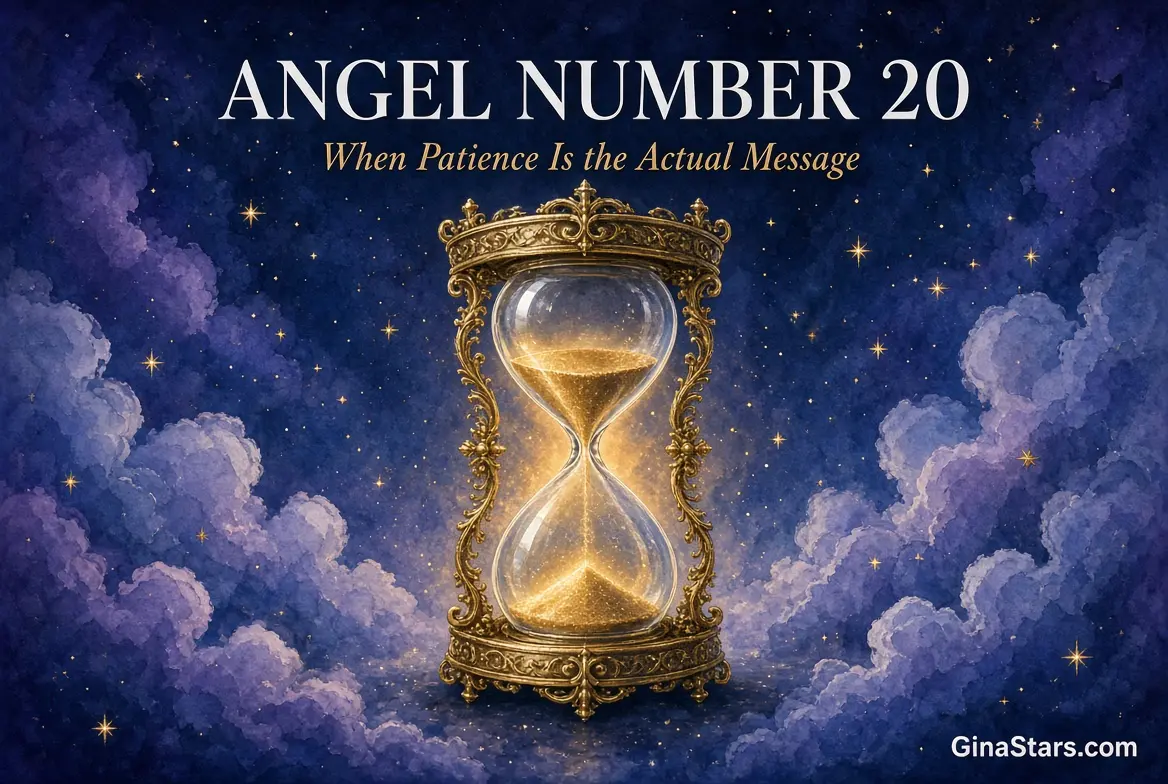
When Patience Is the Actual Message
By Gina, GinaStars
20 is a number that tends to frustrate people when they first understand what it’s saying, because what it’s saying is essentially: this isn’t your moment to move. This is your moment to be steady, to trust the process, to let something develop at its own pace without forcing it forward. That’s a message almost nobody wants to receive when they’re eager for movement.
But 20 appears for a reason, and the reason is usually that the thing you’re waiting for is actually developing. You just can’t see it from where you’re standing.
What 20 Is Made Of
The number 2 opens this sequence. Two is partnership, balance, patience, and the art of cooperation — with other people and with timing itself. It’s the number that asks: how are you showing up in relation to the people and situations around you? Are you contributing to balance or to friction?
The zero that follows amplifies the 2’s energy and adds the quality of divine timing — the sense that there’s a larger order at work than the one you can currently see. Zero in 20 is not absence. It’s the infinite amplifying the patience that 2 is asking for.
The sum of 20 is 2 (2+0). The underlying energy is pure 2, but expanded by the zero’s amplifying quality. Whatever 2 normally asks for, 20 asks for it more completely.
Why Patience Is Harder Than It Sounds
Because patience is usually described as passive — waiting, holding still, not doing anything. That’s not what 20 is asking for. The patience of 20 is active. It’s continuing to do the work, maintain the connection, tend to the relationship or project or situation, while trusting that the result isn’t available yet on your preferred timeline.
There’s a significant difference between patience and passivity. Passive is: doing nothing and hoping things change. Active patience is: doing everything that’s genuinely in your power to do, and then letting the parts that aren’t in your control develop without trying to force them.
20 tends to appear for people who are trying to control the parts that aren’t in their control. Who are pushing on a door that needs to open from the other side. The number is asking: have you done everything genuinely available to you? If yes, then the pushing is the problem, not the pace.
20 and Relationships
Two is the number of partnership, and 20 in a relationship context usually appears when you’re waiting for something in a relationship to develop, shift, or resolve — and the waiting is genuinely what’s required. Someone needs time to process something. A relationship needs time to settle after a change. A dynamic needs to adjust at its own pace rather than being pushed toward resolution.
For people who are impatient in relationships — who need answers, who push for clarity before the other person is ready, who interpret slowness as disinterest — 20 is a very specific message. The slowness is not the answer. The slowness is the timing. Give it what it needs.
20 also sometimes appears when a relationship is in a waiting period that has nothing to do with either person’s hesitation — external circumstances keeping two people from moving forward in the way they want to. A timing that’s not quite right yet. 20 in this context is confirmation that the timing will shift, and that maintaining the connection during the wait is the right approach.
20 and Professional Situations
In a work context, 20 tends to appear when something you’ve put in motion is developing on the other person’s timeline rather than yours. A proposal that’s under consideration. An application that’s being reviewed. A project that’s in someone else’s hands for now. The temptation is to follow up again, to push, to try to accelerate. 20 is asking whether that would actually help or whether it would just create friction.
The honest version: sometimes pushing does help. Sometimes it communicates enthusiasm and initiative. And sometimes it reads as impatience and undermines confidence in your ability to work at the pace the situation requires. 20 is asking you to be honest about which situation you’re actually in.
20 and Trust
The zero in 20 carries a quality of divine support — the sense that the larger process is tending to this even when you can’t see how. For people who are spiritual, 20 often arrives as a reminder that the outcome they’re working toward is also being worked toward by something larger. For people who aren’t spiritual, the practical version is: some things develop through a process that requires time, and trying to shortcut the process produces worse results than letting it complete.
Either way, 20 is asking for trust. Not blind trust — trust grounded in having done what you can do and then letting what can’t be rushed, take its time.
What to Actually Do With 20
Identify the specific thing you’ve been pushing on and ask honestly: is there anything genuinely productive left for me to do here right now? If the answer is no, then the pushing is self-soothing rather than effective action. Do something else. Direct your energy somewhere it can actually move.
Rose quartz supports 20 energy — it’s connected to patience, self-compassion, and the kind of loving persistence that 2 energy asks for. Moonstone helps with the trust piece specifically, supporting the ability to navigate timing you can’t control without becoming anxious.
20 is not asking you to give up. It’s asking you to stop pushing on something that needs to be given space.
-Gina
GinaStars.com