
GinaStars.com
Angelic seals have been around for a long time. They appear in grimoires, in Kabbalistic texts, in medieval manuscripts that most people will never see in person. For most of history they were the territory of scholars, mystics, and people who had access to very specific libraries. Now they’re everywhere — Pinterest boards, tattoo parlors, spiritual influencer accounts — and that widespread availability is both a good thing and a complicated one.
The good thing: more people can access tools that genuinely work. The complicated thing: when something gets popular fast, the context tends to get stripped out, and without context, even real tools produce thin results.
So here’s what I actually know about angelic seals, how they function, and how to use them in ways that go beyond decoration.
What angelic seals are, specifically
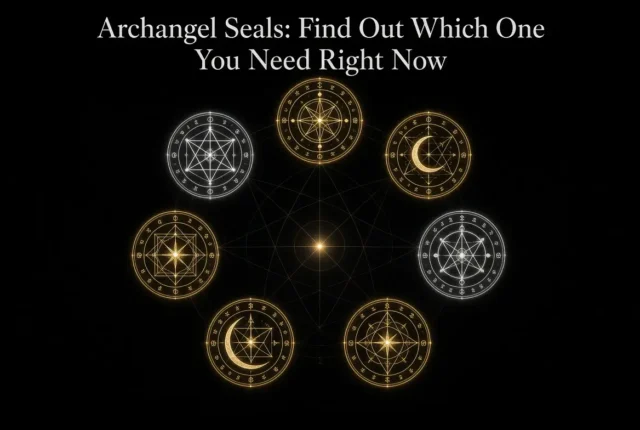
An angelic seal is a symbolic signature — a geometric or pictographic representation associated with a specific angel. The most well-known collection comes from the Ars Goetia and the Key of Solomon, texts that were circulated in occult communities for centuries before becoming widely available. The Seal of Solomon itself is probably the most recognized: the six-pointed star that appears in Jewish mysticism, Islamic tradition, and Western occultism.
But the tradition is broader than those texts. Angelic seals also appear in the works of Heinrich Cornelius Agrippa, in the Heptameron, in Ethiopian Orthodox Christianity’s use of protective talismans called ketab, and in various folk magic traditions across Europe and the Middle East. The specific appearance of each seal varies by tradition, but the underlying idea is consistent: the seal is the angel’s signature, and working with it creates a channel of connection.
The most commonly worked-with seals today come from the 72 angels of the Shemhamphorash — the angels associated with segments of the divine name in Kabbalistic tradition. Each has a specific domain: protection, healing, truth, prosperity, creative inspiration, and so on. When you use a seal, you’re working within a specific domain.
The three main uses: protection, healing, manifestation
These three applications are distinct from each other and benefit from being treated separately.
Protection work with angelic seals is probably the oldest and most documented use. The logic is straightforward: a seal creates a symbolic boundary that reinforces the angel’s presence in a space or around a person. The most commonly used seals for protection include the Seal of Archangel Michael, which appears in numerous folk magic traditions as a ward against harm, and the Pentacle of Solomon, used historically to consecrate spaces.
For protection work, the seal is typically drawn or printed and placed in a specific location: at entryways, under a mattress, carried on the person, or incorporated into a piece of jewelry. The placement matters less than the intention behind it and the consistency with which you engage with it. A seal placed with genuine focus and renewed occasionally through prayer or meditation carries more weight than one printed and forgotten.
Healing work is more internal. The seals most associated with healing include those of Raphael — the archangel whose name means ‘God heals’ and who appears in multiple religious traditions as the patron of health and medicine. Working with Raphael’s seal for healing typically involves meditation with the seal as a focal point, often combined with prayer or specific intention-setting about what needs to heal. This isn’t a substitute for medical care. It’s a spiritual complement to it — something that works on the energetic level of whatever is happening physically or emotionally.
Manifestation work uses seals as a focusing device for intention. The process is more involved than the other two: you identify what you want to bring into your life, identify which angel’s domain corresponds to it, work with that angel’s seal through a ritual of some kind, and then release the outcome. The release part is genuinely important and genuinely difficult. Holding too tightly to the specific form of what you want is one of the most common reasons manifestation work produces thin results.
A seal isn’t a shortcut. It’s a point of contact. What you bring to that contact determines what comes back.
How to actually work with a seal
There are a few different approaches depending on what you’re working with and what feels right for you. I’ll describe the basic process and then variations.
The most fundamental approach is simply drawing the seal yourself, by hand, while focused on your intention. The act of drawing it — slowly, with attention — is itself the beginning of the working. You don’t need artistic skill. You need presence. The seal you draw imperfectly with full attention will work better than one printed perfectly with no attention.
Once drawn, you work with the seal through one or more of the following: prayer or spoken intention directed to the specific angel, meditation with the seal as the focal point while holding your intention in mind, anointing the seal with oil (olive oil works; specific oils associated with the angel’s domain are more precise — lavender for healing, frankincense for protection, cinnamon for abundance), or placing the seal on your altar or in your space with a candle lit nearby.
For protection: draw the appropriate seal, speak your intention clearly (something like: I ask for Archangel Michael’s protection over this space and everyone in it), and place it where you want the protection active. Renew this periodically — weekly, or on new moons — by holding the seal and resetting your intention.
For healing: use Raphael’s seal. Draw it, hold it, and in your meditation, be specific about what you’re asking for healing. Not vague ‘healing energy’ but the specific thing. Physical pain in a specific location. Grief from a specific loss. The specificity is part of what makes the connection real rather than theoretical.
For manifestation: this takes more time. Identify your intention, research which angel corresponds to it (there are good resources online and in books like Damon Brand’s ‘Angels of Alchemy’), draw or acquire that angel’s seal, and work with it for a sustained period — not just once. Consistency over time is part of the mechanism.
What makes a seal working effective vs. ineffective
I’ve thought about this a lot and I think the main variable is genuineness of engagement. Not spiritual sophistication, not years of practice, not the quality of your ritual supplies. Whether you’re actually there, mentally and emotionally, when you do the work.
A five-minute working done with full presence will outperform a thirty-minute ritual performed by rote. This is true of prayer, meditation, and any intentional spiritual practice. The seal is a focusing device. What it focuses is your attention and intention. If those aren’t present, there’s nothing to focus.
The other variable that matters is clarity of intention. ‘I want things to get better’ is not an intention — it’s a wish. ‘I am asking for protection specifically for my home and the people who live in it’ is an intention. ‘I am asking for healing in my relationship with my mother, specifically in how I react when she criticizes me’ is an intention. The more specific and honest you are about what you’re actually asking for, the more precisely the working can respond.
Doubt, on its own, doesn’t block results as much as people fear. Working with doubt is fine — most honest practitioners have plenty of it. What blocks results is performing the working without genuine engagement. Going through the motions is not the same as doing the thing.
One thing most guides don’t say
Angelic seals are not spiritually neutral. They come from traditions that treat angels as real beings with specific natures and domains, not as archetypes or metaphors. Whether you hold that view literally or metaphorically is your own business — both orientations can produce genuine results.
But the tradition these seals come from expects something from the person using them: sincerity. Not perfection of practice, not theological correctness, not extensive study. Sincerity. The genuine quality of asking, of wanting what you’re asking for, of being willing to receive it.
If you’re working with seals as a novelty or an experiment with one foot in and one foot out, you’ll probably get nothing and conclude they don’t work. If you engage with them as if they’re real — as if the angel’s domain is real and you’re genuinely placing something in its care — you’ll likely find they do.
That’s been my experience, anyway.
The seal opens a door. Whether you walk through it depends entirely on you.
SHARE THIS with someone who wants to go deeper with angelic work
— GinaStars.com