
GinaStars.com
This is one of the most consistently surprising things people discover when they go deeper into Human Design: the mind, which most of us treat as the primary decision-making organ, is specifically not designed for that function. In the Human Design system, the mind’s job is to process, to analyze, to communicate, to understand. Not to decide.
The authority — the specific center or mechanism in the body graph that is designed to make decisions — is different for every type. There are eight authorities in the Human Design system, and none of them are the mind. Some are in the gut. Some are in the emotions. Some are in the spleen. Some rely on the voice or the environment. Zero are in the head.
For most people who encounter this, the initial reaction is somewhere between skeptical and disorienting. I have been using my mind to make decisions for my entire life. Are you telling me that was the wrong tool? The honest answer is: for most significant decisions, yes. That is what the system says, and the track record of mind-made decisions in most people’s lives tends to support it.
The mind is the best analyst available and the worst decision-maker. It is extraordinarily good at weighing options, considering outcomes, and building logical cases. It is extraordinarily bad at knowing which option is actually right for you specifically.
Why the Mind Is the Wrong Tool for Decisions
The mind makes decisions based on information, logic, past experience, and — most problematically — fear. It is very good at constructing compelling arguments for whichever option produces the least anxiety in the short term, which is not the same as the option that produces the best outcome. The mind confuses safety with rightness constantly.
It is also susceptible to conditioning. The mind absorbs the priorities of the people around you, the cultural messages about what you should want, the stories you have been telling about yourself since childhood. When you make decisions from the mind, you are often making them from all of that accumulated conditioning rather than from anything that is actually yours.
The body-based authorities that Human Design identifies — sacral, splenic, emotional, and others — operate differently. They respond to what is actually true rather than to what can be logically justified. They are not susceptible to the same conditioning the mind is. And they are faster. The sacral response happens in a fraction of a second. The splenic hit arrives and then disappears. These are not slow deliberative processes. They are immediate responses from a different kind of intelligence.
The Eight Authorities
Emotional Authority — 47% of the population
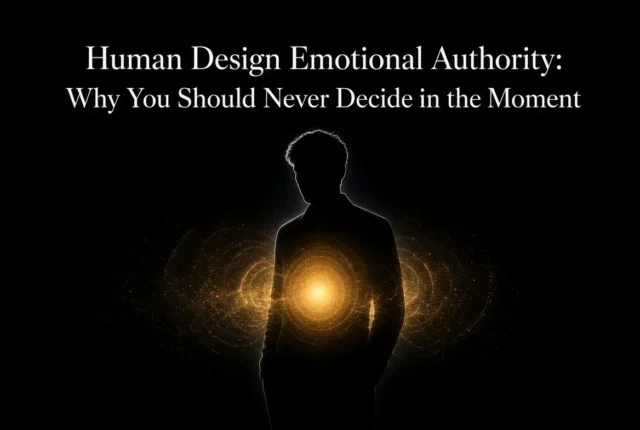
People with a defined Solar Plexus center have emotional authority. This is the most common authority in the system. The core mechanic: never make significant decisions in the moment. The emotional wave — which cycles through highs and lows on its own rhythm, independent of circumstances — needs time to move through a full cycle before a decision can be made clearly. The decision that feels obvious at the peak of the wave often looks different at the low. The one that feels impossible at the low often becomes clear when the wave rises again. Emotional authority people who learn to wait for clarity across the wave make significantly better decisions than those who decide at any one point on the cycle.
Sacral Authority — Generators and Manifesting Generators
Sacral authority is the gut response — the uh-huh or uhn-uhn that arrives before the mind has processed the question. It is involuntary and fast. Sacral authority people make correct decisions by learning to hear and trust this response rather than overriding it with mental reasoning. Yes/no questions work best. ‘Does this feel like a yes?’ Listen for the body’s response before the mind has time to construct a case.
Splenic Authority — Some Projectors and Manifestors
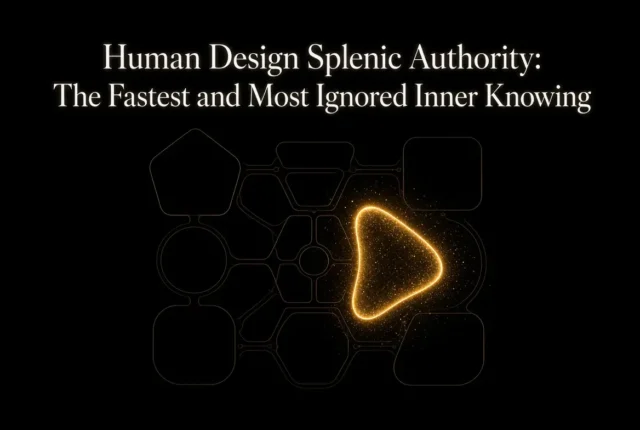
Splenic authority is the oldest intelligence in the body — the mammalian survival instinct. It speaks once, in the present moment, and does not repeat. People with splenic authority need to catch the first hit — before the mind gets involved and constructs reasons to override it. The splenic message is always about safety and health in the present moment. It does not have access to past or future. It only knows right now.
Heart/Ego Authority — Some Manifestors and Projectors
Heart authority people can trust what they genuinely want. The key word is genuinely. Not what they think they should want, not what they have been told they should want — what they actually, honestly want. The heart authority is not common and the people who have it often suppress it by replacing genuine want with performed reasonableness.
Self-Projected Authority — Some Projectors
Self-projected authority people discover what they truly think and feel by talking out loud. Not by processing internally and then reporting — by talking through the question and listening to what comes out of their own mouth. The voice carries the information. They need trusted people to talk to, or to talk aloud to themselves, and to listen for the moment when they hear themselves say the true thing.
Mental/Environmental Authority — Some Projectors
People with no defined authority below the throat are not designed to make decisions internally at all. They are designed to make decisions by being in the right environment and noticing what the environment reveals. The question ‘how does this feel in different places, with different people?’ is more useful than any amount of internal deliberation.
Lunar Authority — Reflectors
Reflectors have no defined centers and therefore no single authority center. Their decision-making aligns with the 28-29 day lunar cycle. Major decisions should be held for a full lunar cycle — noticing how the decision feels as the moon moves through different configurations. This produces access to the full range of possible feelings about a decision rather than one snapshot.
Outer Authority — Some Projectors
Some Projectors have what is called outer authority — meaning their wisdom is not for their own decisions, it is for others. Their clearest knowing often comes when they are helping someone else, not when they are focused on their own choices. This is one of the more counterintuitive aspects of the system and one of the most useful once understood.
How to Start Using Your Authority
Find your authority on your body graph — it is listed explicitly on most chart generators. Then spend two weeks practicing consulting it rather than the mind for small decisions. Not major life decisions first — small ones. What to eat, which route to take, when to stop working. Get familiar with what your authority actually feels like before you rely on it for things that matter more.
The mind will object. It will offer reasons why the authority response is wrong, or premature, or not considering important factors. This is the conditioning speaking. The mind is not wrong that those factors exist. It is wrong that weighing them is how you make correct decisions.
Over time, the distinction between the mind’s input and the authority’s response becomes clearer. The mind talks. The authority responds. Learning to tell the difference is the actual work. Once you can, the decisions that follow tend to look different from the ones that came before. Not always more comfortable. But more genuinely yours.
Your mind is not your enemy. It is just in the wrong job. Give it what it is actually good at — analysis, communication, understanding — and stop asking it to do the one thing it is consistently bad at.
SHARE THIS with someone who has been making decisions from their mind and wondering why things keep not working 🧬✨
— GinaStars.com