GinaStars.com
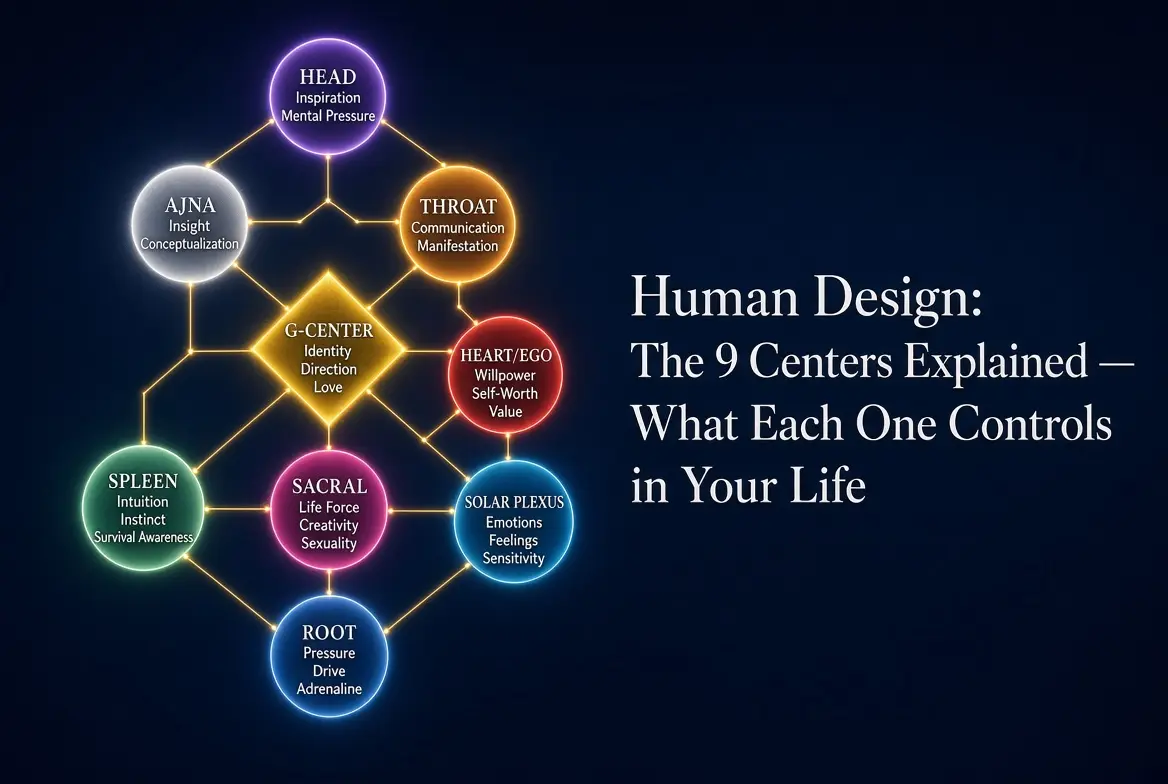
The body graph in Human Design contains nine energy centers. Each one governs a specific domain of your life. When a center is defined — filled in on your chart — it operates consistently, producing the same quality of energy regardless of who you are with or where you are. When a center is undefined — open on your chart — it does not generate its own consistent energy there. Instead, it takes in and amplifies the energy of the people around you.
This is the part that changes everything once you understand it. The inconsistency you experience in certain areas of your life — the areas where you feel reliable sometimes and completely unstable other times, where you absorb other people’s states as if they are your own — that inconsistency is almost always traceable to your open centers.
Here is what each of the nine centers actually governs, and what it means to have it defined or undefined.
A defined center is consistent. An undefined center is responsive. Neither is better. The open centers are where your deepest wisdom lives — once you stop treating their inconsistency as a problem and start treating it as a perceptive capacity.
The Nine Centers
1. The Head Center — Inspiration and Mental Pressure
The Head Center sits at the top of the body graph and governs inspiration, questions, and the pressure to think and understand. It is the center that produces the experience of being mentally active — of questions arising, of the drive to figure things out.
Defined Head: consistent mental pressure. A reliable flow of questions and inspiration that does not depend on external input. People with a defined Head tend to have a particular way their mind works that stays consistent across contexts.
Undefined Head: takes in mental pressure from the environment. The anxiety of other people’s unanswered questions, the pressure to figure out things that are not actually yours to figure out. Most people with an undefined Head spend significant energy trying to resolve questions that are not their own. The wisdom of the open Head is the capacity to hold questions without needing to answer them — to be comfortable in the not-knowing.
2. The Ajna Center — Certainty and Conceptualization
The Ajna is the mind’s processing center — where information gets organized into concepts, opinions, and frameworks. It sits between the Head and the Throat in the body graph and governs the experience of being certain or uncertain about things.
Defined Ajna: consistent mental framework. People with a defined Ajna tend to think in specific, reliable ways. They have opinions that stay relatively stable. The fixed way their mind works is both their strength and sometimes their limitation.
Undefined Ajna: takes in other people’s certainty and mental frameworks. People with an open Ajna are genuinely open-minded in the structural sense — their thinking is flexible, capable of holding multiple perspectives simultaneously. The difficulty is that they can feel pressure to be certain when certainty is not actually available to them. The wisdom here is being comfortable not knowing what they think until they actually know.
3. The Throat Center — Manifestation and Communication
The Throat is the center of manifestation — the place where energy moves from the internal to the external through action and communication. It is one of the most significant centers in the chart because it determines how effectively a person can bring what they intend into reality.
Defined Throat: consistent voice and presence. People with a defined Throat tend to be noticed when they speak — there is a quality to their communication that lands. They can initiate and manifest relatively directly.
Undefined Throat: inconsistent communication and manifestation. People with an open Throat often feel pressure to speak before they are recognized — to fill silences, to speak to get attention, to initiate when the timing is not right. The strategy for an open Throat is to wait to be addressed rather than volunteering. When communication is invited rather than pushed, it tends to be significantly more effective.
4. The G Center — Identity, Direction, and Love
The G Center is the center of identity and direction. It sits at the center of the body graph and governs the sense of who you are and where you are going. It is also associated with love — not romantic love specifically, but the broader experience of loving and being loved.
Defined G: consistent sense of self and direction. People with a defined G have a reliable sense of who they are across contexts. They tend to have a clear direction and to move through life with a certain coherence of identity.
Undefined G: fluid identity that shifts with environment. People with an open G often feel that they are different people in different places and with different people — not in a false way, but genuinely. Their identity is responsive to context. The wisdom of the open G is the capacity to find themselves through experience rather than through fixed self-concept. The practical implication: environment matters enormously for people with an open G. The right places and people literally change who they are.
5. The Heart Center — Willpower and Ego
The Heart Center governs willpower, self-worth, and the ego in the specific sense of the part of the self that makes promises and keeps them. It is connected to the tribal world — to material resources, to proving worth, to the drive to compete and succeed.
Defined Heart: consistent willpower. People with a defined Heart can commit and follow through reliably. They have a consistent drive to prove themselves. The challenge is the tendency to overcommit and the investment of self-worth in achievement.
Undefined Heart: inconsistent willpower. People with an open Heart often take on commitments they cannot sustain because they are trying to prove their worth — to themselves and others. The wisdom of the open Heart is learning that willpower is not a reliable resource for them, and that the pressure to prove themselves is conditioning from the defined Hearts around them rather than an accurate description of what they need to do.
6. The Solar Plexus — Emotional Intelligence and Clarity
The Solar Plexus is the emotional center — it governs feelings, emotional waves, and in defined form, the authority system called Emotional Authority. It is the largest motor in the body graph and the source of the most complex human experience.
Defined Solar Plexus: an emotional wave that cycles through highs and lows on its own rhythm. People with a defined Solar Plexus need to ride this wave before making decisions — clarity arrives over time rather than in the moment. The wave is not a mood disorder. It is the mechanism through which emotional intelligence develops.
Undefined Solar Plexus: takes in and amplifies the emotions of everyone in the environment. People with an open Solar Plexus are emotionally receptive in the literal sense — they feel what others feel, often more intensely than the people generating the feeling. The wisdom of the open Solar Plexus is deep emotional intelligence. The conditioning is the habit of avoiding conflict in order to avoid absorbing the emotional intensity of other people’s reactions.
7. The Sacral Center — Life Force and Sexuality
The Sacral is the most powerful motor in the Human Design system. It governs life force energy, sexuality, work capacity, and the gut response that Generators and Manifesting Generators use to navigate decisions. It is what determines whether a person can sustain energy through a full day of work — and whether that work is genuinely theirs.
Defined Sacral: consistent life force energy that regenerates through correct use. The Sacral responds to the environment with a yes, no, or wait — an involuntary gut reaction that signals alignment or misalignment. Generators and Manifesting Generators both have a defined Sacral.
Undefined Sacral: no consistent life force motor. Projectors, Manifestors, and Reflectors all have undefined Sacrals. They are not designed to sustain the same level of output as Sacral beings. The conditioning is the attempt to work like a Generator — to push through when the energy is gone, to prove capacity through sustained effort. The wisdom is knowing when to stop.
8. The Spleen Center — Intuition and Survival
The Spleen is the oldest intelligence in the body — the mammalian survival system that operates in real time, producing instant intuitive hits about what is safe and what is not. It is the center most associated with physical health, immune function, and the spontaneous knowing that bypasses rational thought entirely.
Defined Spleen: consistent intuitive capacity. The Splenic hit arrives once, quickly, and does not repeat. People with a defined Spleen who learn to trust this hit make better decisions than people who override it with reasoning. The Splenic message is always in the present moment — it does not have access to past or future.
Undefined Spleen: inconsistent intuitive access. People with an open Spleen tend to hold on too long — to relationships, situations, and environments that the body is signaling are not safe, because the signal is inconsistent and the conditioning is to doubt it. The wisdom of the open Spleen is the capacity to recognize safety and danger through the pattern of others’ Splenic energy over time.
9. The Root Center — Adrenaline and Stress
The Root Center is a motor that generates adrenaline — the pressure to get things done, to move, to complete. It sits at the base of the body graph and is responsible for the experience of urgency and the drive to finish.
Defined Root: consistent pressure that gets used and released in a regular cycle. People with a defined Root tend to work well under pressure and to complete tasks reliably. The pressure is their own and they can manage it.
Undefined Root: takes in the adrenaline pressure of everyone in the environment. People with an open Root tend to feel constantly behind, always in a rush, always running out of time — even when they are not. Most of that urgency belongs to the people around them. The wisdom of the open Root is learning to distinguish their own genuine urgency from the ambient pressure they are amplifying from others.
How to Use This Information
Go to your chart. Look at which centers are colored in (defined) and which are white (undefined). The colored centers are your consistent nature — how you reliably show up regardless of context. The white centers are where you are most conditioned by the people around you, and also where your deepest wisdom lives when you stop trying to be consistent there.
The most useful question for each open center: whose energy am I amplifying here, and is it actually mine? That question, asked honestly across the open centers, tends to produce significant clarity about what is actually you versus what you absorbed.
Understanding your centers does not change them. It changes your relationship to them — from trying to fix your inconsistencies to recognizing your inconsistencies as perceptive capacities. That reframe changes everything about how you move through the world.
SHARE THIS with someone who just discovered Human Design and wants to understand their chart 🧬✨
— GinaStars.com