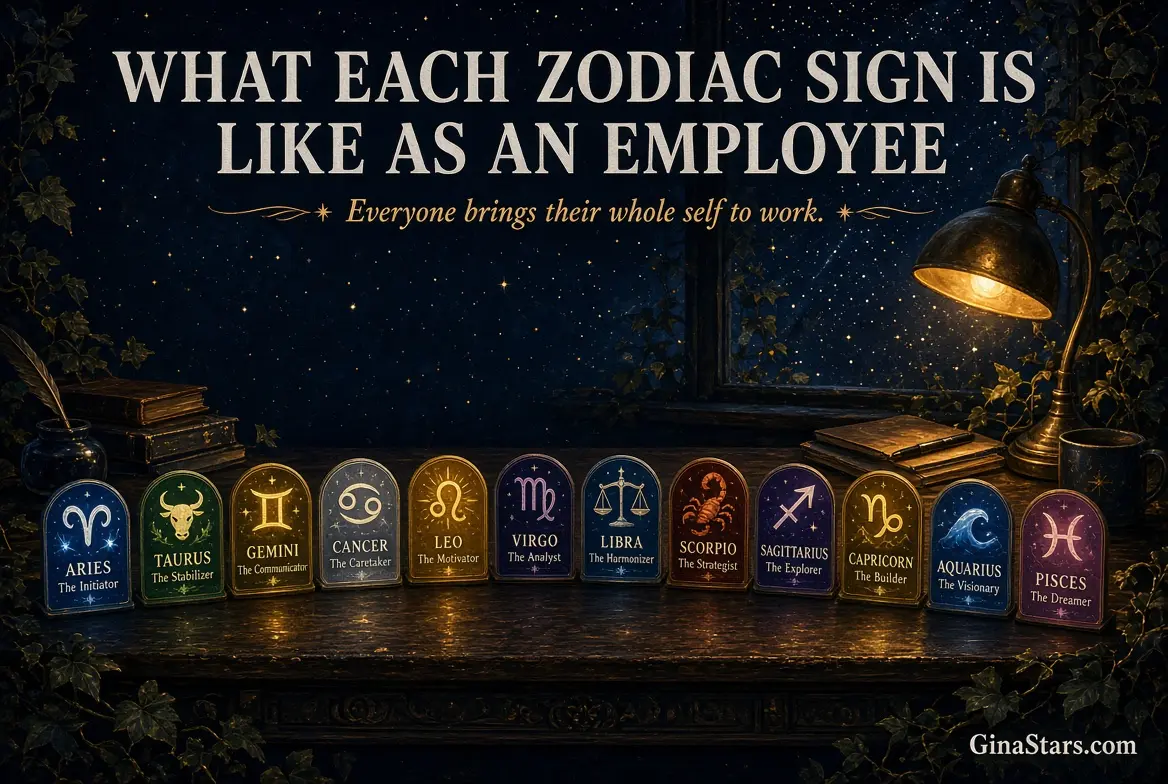
Everyone brings their whole self to work. Here’s what that actually looks like.
By Gina, GinaStars
Being an employee is a different performance than being a boss. When you’re not in charge, different things get expressed and different things get suppressed. The way someone navigates authority they didn’t choose, contributes to a team they didn’t build, and finds meaning in work that wasn’t entirely their idea — that tells you something real about who they are.
Here’s the honest version of how each sign actually operates when they’re not the one running things.
Aries
The Aries employee is highly effective and periodically difficult, and usually the same qualities that produce the effectiveness produce the difficulty. They deliver results, move fast, and have a near-zero tolerance for bureaucratic processes that slow them down without producing anything. They’re the person who asks why every rule exists — and sometimes they have a better answer than the rule does.
The specific challenge of managing an Aries: their effectiveness is completely tied to whether they respect the person above them. Under a boss they believe in they’re outstanding — focused, productive, loyal in the specific way that Aries is loyal when they’ve decided something or someone is worth it. Under a boss they’ve decided is incompetent they become a different kind of problem entirely, and they’re not subtle about the transition.
Aries also gets bored. The initial phase of any role — the new challenge, the learning curve, the sense that they’re building toward something — is when they’re at their best. Once the role has become routine, the restlessness starts. Keeping an Aries engaged requires giving them new problems to solve on a regular basis. Organizations that can do this keep them. Organizations that can’t will lose them or manage the consequences of not losing them.
What Aries is best at: anything that requires fast decision-making, initiative, or willingness to do the thing no one else has volunteered for. What they need from a workplace: enough autonomy that they can work at their pace and enough new challenges that they don’t run out of things to care about.
Taurus
The Taurus employee is the most reliable person in any organization. They do what they say they’ll do, they maintain quality consistently, and they stay. The institutional knowledge they accumulate over time becomes genuinely irreplaceable — they’re the person who knows why the process works the way it does, who trained the last three people who held the adjacent role, who has seen the organization through enough cycles to have actual perspective on what’s happening right now.
The specific challenge: they resist change to the point where legitimate organizational evolution becomes complicated. Not because they can’t adapt — they can — but because their default response to a proposed change is skepticism until the case for it has been made thoroughly enough to satisfy them. And their threshold for thoroughly enough is high. Organizations that want to move fast in new directions will find Taurus employees frustrating. Organizations that need consistent, excellent execution of existing work will find them invaluable.
Taurus also has a specific relationship with their job security that’s worth understanding. They need to feel stable and valued in concrete terms — not just told they’re doing well, but given evidence of it. A raise when the work warrants it. A title that reflects actual responsibility. Consistent positive feedback in a form they can hold onto. When these aren’t present, the loyalty that makes Taurus employees so valuable gradually erodes.
What Taurus is best at: sustained, high-quality execution over long periods, maintaining standards under pressure, building the kind of institutional knowledge that only comes from actually staying somewhere. What they need from a workplace: stability, clear expectations, and regular concrete acknowledgment that the work is valued.
Gemini
The Gemini employee is the most versatile person in the organization. They can do many things, adapt quickly to new requirements, pick up new skills faster than most, and bring genuine energy and creative thinking to whatever they’re working on. In the early stages of any project or role they’re usually among the most valuable contributors.
The specific challenge: sustaining that contribution through the later stages when the novelty has faded. Gemini’s engagement is highest when there’s still something new to figure out and lowest when the work has become routine and the primary requirement is consistent execution. The boredom is visible — Gemini doesn’t hide it well — and boredom in Gemini tends to produce scattered output and distractibility that affects the people around them.
Gemini is also the employee most likely to generate more ideas than anyone can execute, which is either a tremendous asset or a significant problem depending on the environment. In an organization that knows how to filter and develop ideas, Gemini creativity is genuinely valuable. In an organization that expects people to only raise ideas they’re personally going to execute, the Gemini output creates work for other people without a clear owner.
What Gemini is best at: the beginning of things, situations that require rapid adaptation, any role that involves variety and communication. What they need from a workplace: enough variety that the routine doesn’t dominate, enough intellectual stimulation that the mind stays engaged, and a structure that converts their idea-generation into something actionable.
Cancer
The Cancer employee genuinely cares about the work and about the people they work with — and not as a performance. They notice when a colleague is struggling. They remember the context that explains why the meeting went a certain way. They contribute to the emotional fabric of the workplace in ways that are completely invisible until they’re gone, at which point the team often realizes how much was being maintained by someone paying attention.
The specific challenge: vulnerability to the emotional environment in a way that other signs can compartmentalize more effectively. A workplace that is chaotic, politically toxic, or that consistently doesn’t value the people in it will affect Cancer’s performance in ways that a Capricorn or Aquarius might be able to separate from their output. Cancer takes the emotional atmosphere of work personally because they’re personally present in a way that other signs sometimes aren’t.
Cancer is also the employee most likely to go beyond the formal role description in ways that are never quite captured in a performance review. The mentoring they do informally, the culture maintenance, the onboarding of new people, the remembering of birthdays and transitions — this is Cancer’s contribution and it rarely gets recognized with the same currency as deliverables. Organizations that don’t find a way to acknowledge it lose Cancer employees to places that do.
What Cancer is best at: roles that involve genuine care for people, cultures that value the human dimension of work, long-term relationship management with colleagues or clients. What they need from a workplace: a manager who sees them as a whole person, an environment where the culture is actively good rather than just professionally acceptable, and recognition for contributions that don’t show up in traditional metrics.
Leo
The Leo employee performs best when their contribution is visible and acknowledged — not as a character flaw but as a genuine fuel source. When Leo feels seen and valued they work harder than almost anyone. The commitment is real, the output is excellent, the energy they bring raises the energy of the people around them. When they don’t feel seen and valued they check out, and the checkout is gradual and then very complete.
The specific challenge: the recognition requirement. Most workplaces don’t think carefully about this, and the cost of not thinking carefully about it with Leo employees is disproportionate to what the thinking would have required. A specific, genuine acknowledgment of good work — not generic praise, but the kind that demonstrates someone actually noticed what was done and how — is what Leo needs to stay engaged. The organizations that figure this out get exceptional performance. The ones that dismiss it as vanity get an expensive resignation.
Leo is also the employee most likely to take on visible work and least likely to thrive in roles where the contribution is genuinely invisible. They can do the work — they can do most work — but the sustained motivation for work that no one sees requires effort that other signs don’t need to expend.
What Leo is best at: customer-facing roles, presentations, anything that involves representing the organization or the team externally. What they need from a workplace: specific recognition, visibility for their contributions, and a manager who understands that acknowledging good work isn’t flattery — it’s management.
Virgo
The Virgo employee produces the best work in the organization and has opinions about how everyone else is doing their work too. Not always expressed, but present. The quality standard they hold for themselves is genuinely high, the attention to detail is real, and the output they deliver consistently exceeds what most roles explicitly require.
The specific challenge: the same standards applied internally become criticism applied externally when the stress is high enough or the patience has run out. The Virgo who is managing their own output impeccably and watching colleagues produce work that doesn’t meet their standard will eventually say something. How they say it and to whom determines whether that honesty is an asset to the organization or a problem.
Virgo also struggles to delegate in any meaningful sense because delegation requires accepting that someone else will do the thing differently, which usually means less precisely. In roles where Virgo has reports or collaborative dependencies, this tendency becomes a bottleneck. The work that goes through Virgo is excellent. The work that should be moving through Virgo to somewhere else sometimes doesn’t move fast enough.
What Virgo is best at: quality control, any role where precision is the primary requirement, analysis, editing, process improvement. What they need from a workplace: clarity about what the standard actually is before they start, a manager who gives feedback with enough specificity to be useful, and the authority to maintain quality in their domain without constant explanation of why quality matters.
Libra
The Libra employee excels at relationships — with colleagues, with clients, in any situation that requires managing multiple stakeholders with different and competing needs. They’re the person the organization needs in every meeting where things could go sideways, because Libra can hold multiple perspectives simultaneously and find language that doesn’t force anyone to lose.
The specific challenge: the conflict avoidance that allows problems to persist past the point where addressing them would have been easier. Libra sees the problem. Libra understands the problem. Libra waits for the problem to resolve itself or for someone else to address it because addressing it means creating discomfort that Libra is structurally averse to creating. Organizations that need people who will name problems clearly and early will find Libra’s diplomacy frustrating.
Decision-making is also consistently slower than the pace of most organizations would prefer. The Libra employee is not being indecisive out of incompetence — they’re being thorough in a way that their process requires. The cost of rushing them is usually a worse decision. The cost of not rushing them is the missed deadline or the opportunity that closed while the decision was still being made.
What Libra is best at: client relationships, team dynamics, any role that requires navigating competing interests without casualties. What they need from a workplace: enough time to make decisions properly, a manager who appreciates the diplomatic contribution rather than just pushing for faster outputs, and colleagues who will help name conflicts rather than leaving it entirely to Libra to manage.
Scorpio
The Scorpio employee is quietly the most powerful person in any organization regardless of title. They understand the real dynamics — not the org chart, the actual power structure. They know who makes things happen and who appears to, who is trustworthy and who performs trustworthiness. They navigate all of this without making their navigation visible, which gives them an effectiveness that people in nominally higher positions sometimes don’t match.
The loyalty they extend to an organization and to the people in it is real and fierce when it’s been earned. They will do things for an organization they believe in that go significantly beyond what their role technically requires. They will advocate for colleagues who deserve advocacy. They will maintain confidentiality in situations where other employees would leak. The loyalty is genuine and operates on a long timeline.
The specific challenge: the loyalty is conditional and the conditions are specific, and when those conditions are violated — through dishonesty, through being passed over without explanation, through being underestimated by someone who should know better — the response is complete and non-negotiable. The Scorpio who has decided the organization doesn’t deserve their loyalty is a different person from the one who decided it did. Organizations often don’t realize the transition has happened until the resignation is already submitted.
What Scorpio is best at: roles requiring discretion, investigation, or the navigation of complex organizational dynamics. What they need from a workplace: honesty from above, recognition that doesn’t require them to perform gratitude, and the clear sense that the people making decisions are actually competent.
Sagittarius
The Sagittarius employee is excellent at roles that involve moving, adapting, learning, and bringing perspectives from outside the organization’s existing framework. They’re the person who has read the thing no one else has read, who makes the connection between what the organization is doing and what a completely different industry solved three years ago, who brings genuinely different input to problems that have been stuck.
The specific challenge: low tolerance for the bureaucracy, mediocrity, and organizational politics that exist in most workplaces. Sagittarius can work around these things for a while, especially when the work itself is interesting and the direction feels meaningful. But an organization that says it values innovation while actually rewarding conformity, or that talks about growth while actually managing for comfort, will eventually exhaust Sagittarius’s capacity for working inside the gap between stated and actual values.
Sagittarius is also the employee most visibly unhappy before they resign. They don’t hide it well. The restlessness, the philosophical questions about whether this is the right direction, the comparison of the current situation to hypothetical alternatives — it’s in the room before the resignation letter is. Organizations that pay attention to this can sometimes address the underlying issue. Organizations that don’t will lose someone who was telling them what was wrong for months before the exit.
What Sagittarius is best at: roles requiring breadth of knowledge, rapid learning, or the ability to represent the organization to genuinely diverse audiences. What they need from a workplace: actual freedom rather than performed freedom, work that feels meaningful rather than arbitrary, and the honest version of the situation rather than the managed version.
Capricorn
The Capricorn employee has a five-year plan and the organization is in it or it isn’t. They bring sustained focus, professional seriousness, and the willingness to do difficult things competently without requiring encouragement or validation for each step. They can take on significant responsibility without being destabilized by it.
The specific challenge: they work for outcomes they can see as contributing to their own longer trajectory. If the role is clearly developing the Capricorn toward where they’re going, they’ll invest significantly. If it stops doing that — if the role hits a ceiling, if the organization’s direction diverges from their own, if the growth that was implied at hiring isn’t materializing — they’ll disengage quietly long before they resign. The disengagement is private and professional and the organization often doesn’t detect it until the notice period has already begun.
Capricorn is also the employee who will work extremely hard for an organization that is genuinely going somewhere and almost not at all for an organization that is maintaining the status quo. The effort is calibrated to the trajectory. Organizations with genuine ambition get Capricorn’s genuine effort. Organizations without it get their reliable professional minimum, which is still good but is not what Capricorn is capable of when they’re invested.
What Capricorn is best at: high-responsibility roles, situations that require sustained effort over long periods, anything where the quality of the judgment matters as much as the quantity of the output. What they need from a workplace: a clear path that is developing their capabilities, honest feedback about where they stand, and the evidence that the work they’re doing is contributing to something real.
Aquarius
The Aquarius employee brings ideas that are genuinely different from what the organization has considered before, and doesn’t fully understand why those ideas need to go through so many layers of approval before they can be tested. The resistance to hierarchy isn’t performative — it’s a genuine conviction that the hierarchy adds friction without adding value, which is sometimes true and sometimes missing the point of why the structure exists.
They do their best work when given significant autonomy and a real problem to solve. The combination of intellectual freedom and genuine stakes produces Aquarius at their best — focused, creative, productive in ways that surprise people who have only seen the less-engaged version. The less-engaged version appears in environments that require conformity, that reward appearance over substance, that manage for comfort rather than for results.
The specific challenge: they don’t perform well in the social requirements of workplaces that value the performance of engagement — the meetings that exist to show alignment rather than to achieve it, the communications that are diplomatic rather than honest, the culture of managed consensus rather than genuine debate. Aquarius finds this exhausting in a way that other signs have more tolerance for, and the exhaustion eventually shows in ways that the organization reads as attitude rather than as feedback about the culture.
What Aquarius is best at: roles with real intellectual autonomy, situations that require unconventional problem-solving, any environment that values actual thinking over the appearance of it. What they need from a workplace: the real version of the situation rather than the managed version, colleagues who engage with ideas rather than with positions, and enough autonomy that the work is genuinely theirs.
Pisces
The Pisces employee brings creative thinking, genuine emotional intelligence in team dynamics, and an ability to imagine solutions that aren’t obvious from inside the problem. They’re the person who finds the unexpected angle, who makes the connection that the more linear thinkers in the room didn’t make, who creates things that resonate in ways the brief didn’t specify but that turn out to be exactly right.
The specific challenge: they absorb the emotional environment of the workplace significantly, more than they can always separate from their own state. A chaotic or politically toxic environment affects Pisces output in ways that other signs manage better — not because Pisces is less capable, but because the permeability that makes them excellent at reading what’s needed is the same permeability that makes the surrounding emotional atmosphere their emotional atmosphere.
Pisces also works best in environments that are psychologically safe enough to allow the creative process its natural uncertainty. The early stage of creative work is uncertain and Pisces needs enough security to sit in that uncertainty without immediately resolving it into something more defined. High-pressure environments that need certainty fast will get less from Pisces than lower-pressure environments that give the work room.
What Pisces is best at: creative roles, any work that benefits from genuine emotional intelligence, situations where the unexpected connection or approach is more valuable than the obvious one. What they need from a workplace: psychological safety, enough stability that the creative process has somewhere to happen, and managers who understand that the work is coming from somewhere real even when the process looks uncertain.
Gina
GinaStars.com