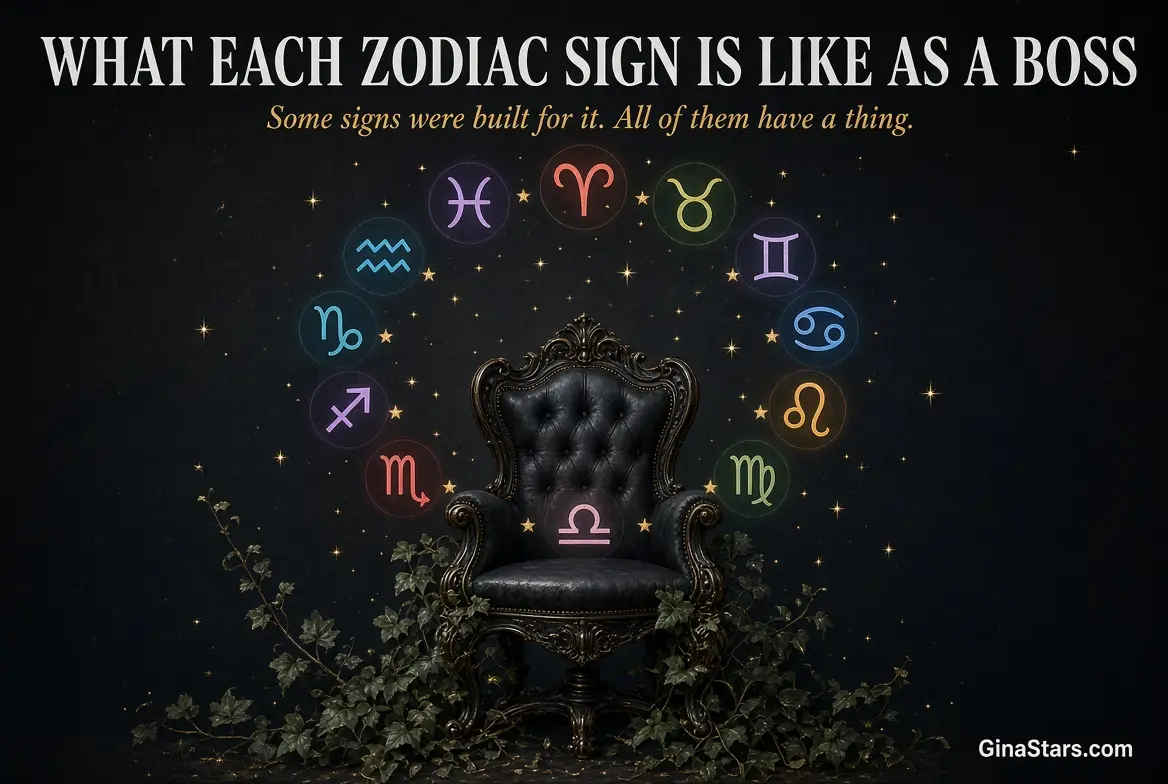
Some signs were built for it. Some signs were built to lead a specific kind of team. All of them have a thing.
By Gina, GinaStars
Being a boss is one of the clearest expressions of a sign’s actual values rather than their performed ones. How someone uses authority when they have it tells you almost everything about who they really are. The patience they claim to have, the fairness they describe themselves as having, the care for people they express in theory — all of it gets tested when there are actual people reporting to them and actual decisions to be made.
Here’s the honest version of what each sign is actually like when they’re the one in charge.
Aries
The Aries boss moves fast and expects you to keep up. They’re excellent in a crisis — decisive when everyone else is still assessing, clear about direction when clarity is what’s needed, energizing in a way that makes hard periods feel survivable. Their energy creates momentum and momentum is genuinely useful.
The problems are specific: they make decisions without enough information because waiting felt worse than deciding, they deliver feedback with a directness that can register as harshness when they intended it as efficiency, and they lose patience with processes that exist for legitimate reasons but feel slow to them. They also forget that not everyone operates at their pace and can interpret normal human working speed as insufficient effort.
The Aries boss at their best: the person you want running things in an emergency. Clear, fast, decisive, genuinely willing to make the hard call.
What working for them requires: match their energy when you can, be direct when you need something, don’t take the bluntness personally, and push back when you disagree — they respect that more than deference.
Taurus
The Taurus boss creates stability. The environment is consistent, the expectations are clear, the standards don’t change based on what mood they’re in today. If you deliver what you committed to, you’ll be treated well. If you show up reliably, you’ll have an employer who values and keeps you. The predictability is a genuine gift in a working world that’s often chaotic.
The problems: they resist innovation past the point where the resistance is reasonable, take longer to change course than the situation sometimes requires, and can be inflexible in ways that create unnecessary friction when flexibility would have been the better choice. They also tend to make decisions based on how things have always been done, which is useful when how things have always been done is working and costly when it isn’t.
The Taurus boss at their best: the person who builds something that lasts, who maintains quality consistently, whose team stays because the environment is genuinely good.
What working for them requires: prove yourself through consistency rather than through big ideas. They’ll take the big ideas eventually, once you’ve demonstrated you can execute the small ones.
Gemini
The Gemini boss is genuinely stimulating to work for — they’re interested in ideas from anywhere, they listen to people regardless of their position in the hierarchy, and the best idea wins regardless of whose idea it was. The intellectual environment is usually excellent. The strategic consistency is another matter.
The problems: the direction changes with their thinking, which changes frequently and without always sufficient communication to the people who need to adjust their work accordingly. The verbal commitment and the written commitment can differ. The interest in a project can shift before the project is complete, leaving people working on something that has lost its champion.
The Gemini boss at their best: the one who creates an environment where genuine thinking is rewarded, where unconventional approaches get a fair hearing, where the work feels intellectually alive.
What working for them requires: bring ideas, be adaptable, and ask for clarity in writing when decisions are made. A conversation with a Gemini boss is not the same as a documented agreement.
Cancer
The Cancer boss knows what’s happening in people’s lives and factors it in. They remember that someone’s parent is sick, that someone just moved, that someone has been having a hard month. The team feels known rather than just employed, which produces a loyalty that other management styles don’t generate. People work hard for a Cancer boss because the Cancer boss clearly cares about them as people.
The problems: difficulty with conflict and criticism that needs to be delivered, tendency to take team problems personally, decisions sometimes based on loyalty rather than performance, and an emotional investment in the team that can become enmeshment. The Cancer boss can also struggle to let people go when letting them go is the right thing for the organization.
The Cancer boss at their best: the team that performs better than expected because they feel genuinely safe, supported, and known. The retention rate is usually excellent.
What working for them requires: reciprocate the care, communicate problems early rather than waiting until they’re crises, and understand that their investment in the team is genuine and takes the team’s behavior personally in both directions.
Leo
The Leo boss is genuinely inspiring when they’re at their best. They create a sense of purpose around the work, communicate a vision that makes people feel like they’re part of something, and have a warmth and charisma that makes the team proud to be associated with them. They also tend to attract talented people because talented people want to work for someone who will recognize and celebrate what they do.
The problems: they can take up more space than is appropriate, need more validation than a boss probably should, struggle to share credit with genuine generosity when projects succeed, and can make the team’s work feel like it’s in service of Leo’s narrative rather than the team’s shared purpose. The Leo boss who hasn’t done the work on their ego is significantly harder to work for than the one who has.
The Leo boss at their best: the leader who makes everyone feel like they’re capable of more than they thought, who champions their people publicly, who creates genuine esprit de corps.
What working for them requires: acknowledge their vision genuinely, take on visible work they can champion, give them the credit in public settings — they’ll share it back in the ways that matter.
Virgo
The Virgo boss has the highest standards on this list, full stop. Work for a Virgo and your output will improve whether you want it to or not, because the standard is explicit, consistent, and non-negotiable, and the feedback when you fall short of it is precise enough to be genuinely useful even when it’s uncomfortable to receive.
The problems: micromanagement that prevents the team from developing their own competence, critical feedback that lands as personal even when intended as professional, difficulty delegating trust to people who do things differently than they would, and a tendency to take on too much themselves because the alternative is accepting someone else’s version of quality.
The Virgo boss at their best: the team that produces genuinely excellent work, that has learned things about their craft they wouldn’t have learned anywhere else, that has been held to a standard they’re ultimately grateful for.
What working for them requires: be detail-oriented, own your mistakes immediately and with a plan for correction, and ask specifically what excellent looks like before you start the work rather than finding out after you’ve finished it.
Libra
The Libra boss wants consensus and has built processes for achieving it. Everyone gets heard. Every perspective gets considered. The team feels respected and included in ways that other management styles don’t produce. The culture is usually pleasant, the interpersonal dynamics are usually well-managed, and fairness is genuinely valued and practiced.
The problems: decisions take longer than the situation can accommodate because the consultation process is thorough and Libra’s own decision-making requires weighing things from multiple angles. In fast-moving situations the Libra boss can be a liability through no fault of their values — the situation moved on before the consensus was reached. They also avoid conflict past the point where avoiding it creates problems that conflict would have resolved.
The Libra boss at their best: the team that feels genuinely respected, that produces better work because the environment is psychologically safe, that stays longer because the culture is actually good.
What working for them requires: engage genuinely in the consultative process rather than performing engagement. And have patience for the decision timeline, which is slower than you’d like for legitimate reasons.
Scorpio
The Scorpio boss knows more about what’s happening in the organization than their direct reports realize. They see the dynamics, understand the politics, know who is actually doing what and how the informal power structure maps onto the formal one. They navigate all of this without revealing how much they’re tracking, which can feel either reassuring or unnerving depending on where you’re standing.
The loyalty the Scorpio boss extends to their team is real and fierce when it’s been earned. They will fight for their people in rooms those people don’t have access to. They will remember who showed up when things were hard. The loyalty runs deep and operates on a long timeline.
The problems: the trust is slow to build and when it’s lost it’s lost completely, with no clear path back. The management style can feel opaque because the Scorpio boss reveals less than they know. And the intensity of the environment can be exhausting for people who work better with more explicit positive feedback.
What working for them requires: be honest, don’t play organizational politics with or around them, and understand that earning their trust is a long game that’s worth playing.
Sagittarius
The Sagittarius boss is excellent at the vision and genuinely inspiring in the direction-setting phase. They communicate where things are going with a conviction that makes people want to go there, they attract talent through the quality of what they’re building toward, and the intellectual environment around them is usually stimulating and alive.
The problems: the vision can outrun the operational reality, the details that someone needs to manage for the vision to become real can get insufficient attention, and the Sagittarius boss can lose patience with the administrative friction of actually running something. They’re also most energized by the new and least interested in the mature stage of a project, which can leave teams in the middle of important work feeling underchampioned.
The Sagittarius boss at their best: the person who builds something genuinely meaningful and attracts the people who are excited to build it with them.
What working for them requires: take ownership of execution details they miss, align genuinely with the vision, and understand that the big picture they’re painting is real even when the path to it is still being worked out.
Capricorn
The Capricorn boss respects results. Not effort, not potential, not the explanation of why the thing didn’t happen — results. They hold high standards, they don’t give feedback until they’ve assessed your competence, and the warmth in the relationship comes after the professional trust has been established, not before.
This can feel cold to people who are used to environments where the relationship comes first. It’s not cold — it’s structured. Capricorn values demonstrated performance and builds the relationship from there, which produces working relationships that are more durable than the ones built on warmth before competence has been established.
The problems: standards that aren’t always communicated before they’re applied, a tendency toward overwork that the team is expected to match, and a difficulty expressing appreciation in ways that people who need more explicit positive feedback can receive.
The Capricorn boss at their best: the team that has learned more than they thought possible, that has been held to a standard that genuinely elevated their work, that has an advocate who will support their career long after they’ve stopped working directly together.
What working for them requires: deliver results before asking for flexibility. The accommodation comes after the trust, and the trust comes from the work.
Aquarius
The Aquarius boss is the most likely to treat everyone on the team as an intellectual equal regardless of title, which some people find refreshing and some people find confusing. They’re genuinely interested in ideas from anywhere, resist hierarchy for its own sake, and create environments where unconventional approaches get taken seriously. The intellectual freedom is real.
The problems: the emotional disconnection that can make feedback feel clinical rather than caring, the difficulty with the interpersonal dynamics that are not about ideas, and the management of people who need more explicit relational engagement than Aquarius naturally provides. They’re also not always attentive to the political dimensions of the organization, which can leave the team without sufficient top-cover when they need it.
The Aquarius boss at their best: the environment where genuinely unconventional thinking is rewarded, where people feel free to bring their real perspectives rather than the ones they think are wanted.
What working for them requires: contribute ideas, be direct about what you need, and don’t expect the relational check-ins other bosses might provide. The engagement is intellectual and real even when the emotional register is lower than you’d like.
Pisces
The Pisces boss has genuine creative vision and genuine empathy for the people on their team. The creative environment they create is often excellent — the ideas flow, the people feel free to explore, the work has a quality of aliveness that more structured environments don’t produce. They also understand their team as people in a way that matters.
The problems: the direction can be unclear in ways that cost people time and effort, the conflict avoidance allows personnel problems to persist past the point where addressing them would have been easier, and the organizational requirements of actually managing people — performance reviews, difficult conversations, clear expectations — can get insufficient attention. The Pisces boss often needs strong operational support to function at their best.
The Pisces boss at their best: the creative environment where people produce work they’re genuinely proud of, where the culture is warm and the ideas are good.
What working for them requires: communicate clearly and explicitly because they read between lines and sometimes read incorrectly. Help with practical structure when you can. Contribute creatively and generously.
Gina
GinaStars.com